استراتيجية الذكاء الاصطناعي
/
16 فبراير 2025
Claude Fable 5: What Anthropic's Powerful Model Means for Business Automation
Claude Fable 5 is Anthropic's most powerful AI model yet. Discover what's new, its pricing, and how its agentic capabilities transform business automation.
/
مؤلف

غرايسيا بيركين
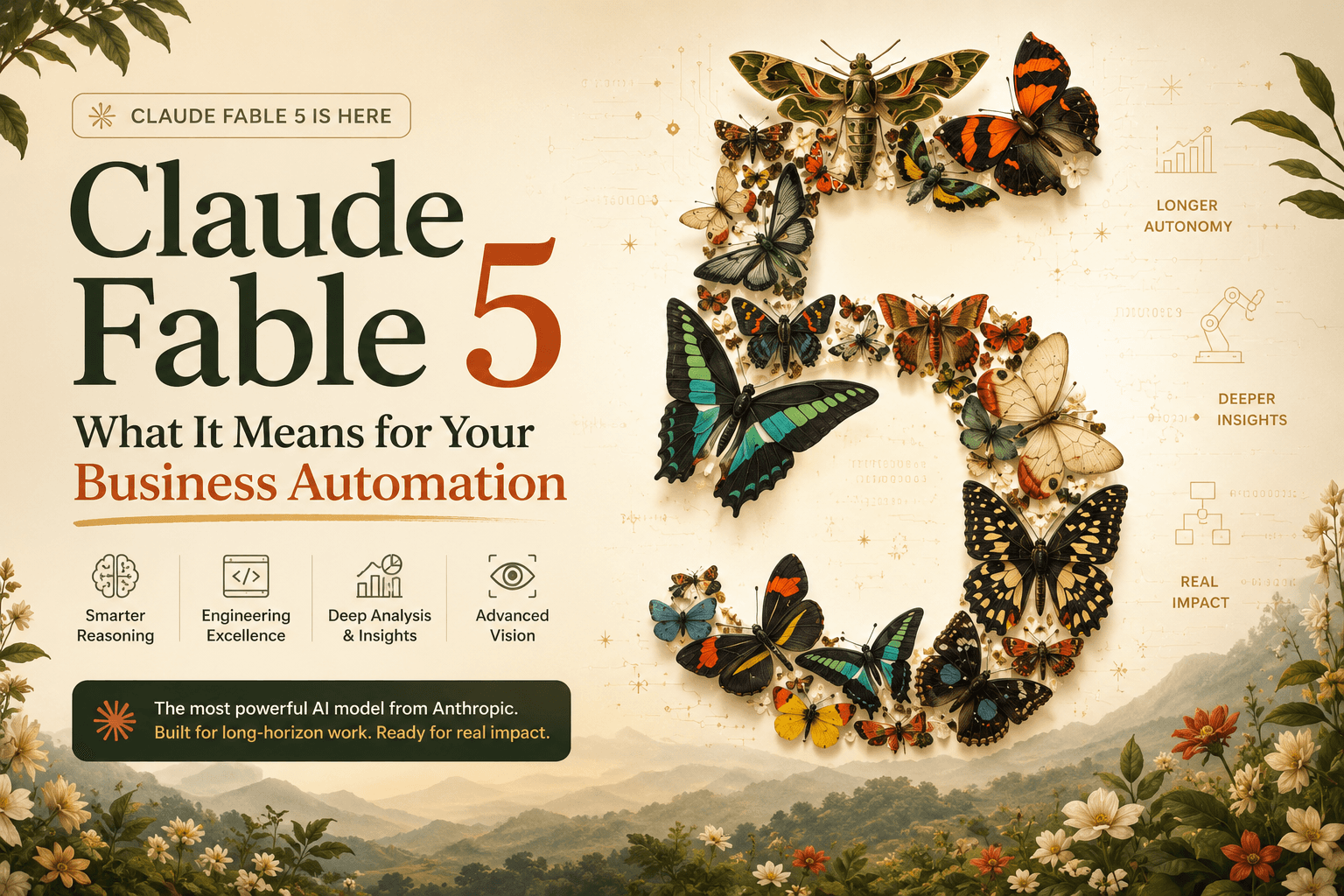
On June 9, 2026, Anthropic launched Claude Fable 5, the most capable AI model it has ever made generally available. Days later, US export controls briefly took it offline and as of July 1, it's back globally with stronger safeguards than any model Anthropic has shipped.
It belongs to a brand-new "Mythos-class" tier that sits above Claude Opus, and early enterprise testing suggests it changes what businesses can realistically automate.
At ZeluAI, we build custom AI agents and automation systems on frontier models, so we've been watching this launch closely. Here's what's new, what it costs, and what it actually means for your business.
What Is Claude Fable 5 and Why Is It Different from Previous Claude Models?
Claude Fable 5 is Anthropic's flagship AI model, released on June 9, 2026, as the first generally available model in the Mythos class, a capability tier above the Opus models, and updated to Fable 5.1 on September 1. According to Anthropic's official announcement, Fable 5 is state-of-the-art on nearly every tested benchmark, and its lead grows as tasks get longer and more complex.
That last point matters more than any single benchmark score. Most business processes aren't one-step tasks, they're long chains of decisions, lookups, and actions.
A New Model Tier Above Claude Opus
Mythos-class isn't just a version bump. Anthropic created an entirely new tier because the capability jump was large enough to warrant one.
Fable 5 shares its underlying model with Claude Mythos 5, a restricted version reserved for approved cybersecurity and research organizations. The difference is safeguards: Fable 5 ships with safety classifiers that route certain sensitive queries to Claude Opus 4.8 instead.
In practice, Anthropic reports these fallbacks trigger in less than 5% of sessions. For everyday business use automation, analysis, content, coding, you're getting full Mythos-level capability.
Built for Long-Horizon Autonomous Work
The headline improvement for businesses is autonomy. Fable 5 can work independently for longer than any previous Claude model, staying focused across millions of tokens and even using its own notes to improve its output as it goes.
Why does that matter? Because autonomy is the difference between an AI that assists with steps and an AI that completes workflows.
This is exactly the capability that powers modern agentic systems. As we explained in our guide on Agentic RAG: How AI Agents Use Retrieval-Augmented Generation, agents that can reason, retrieve, validate, and self-correct over many steps consistently outperform single-shot automation. Fable 5 raises the ceiling on how far those loops can run.
What Are Claude Fable 5's Standout Capabilities?
Benchmarks are useful, but real-world results from early access customers tell the clearer story. Three areas stand out for business applications: engineering, knowledge work, and vision.
Software Engineering That Compresses Months into Days
The most striking early result came from Stripe. In a 50-million-line codebase, Fable 5 completed a codebase-wide migration in a single day, work Stripe estimated would have taken an entire engineering team more than two months by hand.
Fable 5 also scored highest among frontier models on Cognition's FrontierCode evaluation, which tests whether AI can meet the standards of production-quality codebases.
For businesses, the takeaway is simple: custom software and automation builds that once took quarters can now happen in weeks.
Stronger Knowledge Work and Analysis
Fable 5 posted the highest score of any model on Hebbia's Finance Benchmark for senior-level reasoning, with major gains in document-based reasoning and chart and table interpretation.
One early tester reported Fable 5 was the first model to break 90% on their benchmark of complex, long-running analytical tasks ,a ten-point jump over Opus.
If your workflows involve heavy documents contracts, reports, financial statements, compliance files, this is the capability that turns AI from a summarizer into a genuine analyst.
State-of-the-Art Vision Capabilities
Fable 5 is now Anthropic's strongest model for visual tasks. It can extract precise numbers from dense scientific figures and even rebuild a web application's source code from screenshots alone.
For day-to-day operations, vision improvements translate into more reliable invoice processing, document digitization, form extraction, and visual quality checks, the unglamorous automation work that saves real hours.
Automating Tools That Have No API
Not every system a business relies on offers a clean way to connect to it. Legacy internal tools, older supplier portals, and niche platforms often have no public API at all, which has traditionally meant those workflows stayed manual no matter how repetitive they were.
Fable 5 changes this by driving local browser tools directly through Claude Code, watching how a manual process is done, then replicating the click-through actions end-to-end.
For businesses stuck manually re-entering data between two systems that were never designed to talk to each other, this closes a gap that automation tools have struggled with for years.
How Much Does Claude Fable 5 Cost and When Can You Access It?
Claude Fable 5 is priced at $10 per million input tokens and $50 per million output tokens, less than half the price of Anthropic's previous Mythos Preview model. Following the July 1 redeployment, it's available globally through the Claude API (model name claude-fable-5), Claude.ai, Claude Code, and Claude Cowork.
The pricing story is bigger than it looks. Fable 5 is also more token-efficient than previous Claude models, meaning it completes tasks in fewer steps. Frontier capability at this price point makes automation projects viable that simply didn't make financial sense a year ago.
What's New in Claude Fable 5.1?
On September 1, 2026, Anthropic shipped Claude Fable 5.1, its first update since Fable 5 launched back in June, and it's now the default Fable model. According to Anthropic's own documentation, Fable 5.1 "extends Claude Fable 5 at the same input and output prices... and brings stronger long-running agentic coding, multistep research, and document, spreadsheet, and slide work."
Cache reads dropped 75%, from $1.00 per million tokens down to $0.25 per million tokens, while base input and output pricing stayed exactly where it was at $10 and $50 per million tokens.
On the capability side, the gains are real but specific. Fable 5.1 more than doubled its score on Terminal-Bench-Science, and posted meaningful gains on CursorBench, a benchmark focused on agentic coding tasks that reward genuine reasoning depth over memorization.
Anthropic also introduced a sibling model, Mythos 5.1, which shares the same underlying capabilities but remains restricted to vetted cybersecurity and life-science organizations, similar to how Mythos 5 relates to Fable 5.
One practical note worth knowing: since Claude Opus 5.5 launched on September 22, Anthropic's own model guidance says to start with Opus 5.5 for most workloads, and to use Fable 5.1 for demanding reasoning and long-horizon agentic work, or when Opus 5.5 at higher effort still falls short.
Fable 5.1 launched with day-one availability across the Claude API, AWS, Google Cloud, and Microsoft Foundry, the same context window (1 million tokens) and max output (128,000 tokens) as before, so nothing changes for businesses already integrated with Fable 5 beyond the higher capability ceiling.
WHY WAS CLAUDE FABLE 5 TEMPORARILY UNAVAILABLE - AND WHAT CHANGED?
If you tried to use Fable 5 in mid-June and couldn't, here's what happened.
On June 12, three days after launch, the US government applied export controls to Fable 5 and Mythos 5. Because the order took effect immediately and nationality couldn't be verified in real time, Anthropic suspended access for all users worldwide. On June 30, the controls were lifted, and both models were redeployed on July 1.
What Triggered the Suspension?
Researchers at Amazon found a method of bypassing Fable 5's safeguards, prompting it to identify software vulnerabilities. Anthropic's testing later confirmed that many less capable models including Claude Opus 4.8, GPT-5.5, and Kimi K2.7, could perform the same tasks. In other words, the technique didn't expose any unique frontier-level danger. But given the stakes, the government acted first and asked questions after.
What Changed With the Redeployment?
Fable 5 returned with an improved safety classifier that blocks the reported technique in over 99% of cases. The trade-off: the new classifier occasionally flags benign coding and debugging requests, routing them to Opus 4.8 instead. Anthropic says it's actively refining this to reduce false positives.
Anthropic also announced an industry jailbreak-severity framework with Amazon, Microsoft, and Google, plus deeper pre-release testing with the US government meaning future launches should be less likely to face surprise disruptions.
For businesses, the episode carries one practical lesson we unpack below: frontier model availability is now a continuity factor worth designing for.
What Does Claude Fable 5 Mean for Your Business Automation?
Here's the practical question: what changes for your business? In our view, the gap between "AI that assists" and "AI that completes work" just narrowed significantly and that shifts what's worth automating.
AI Agents That Finish What They Start
Long-horizon autonomy means agents can now own complete workflows rather than individual steps.
Think of an IT support agent that doesn't just suggest a fix but investigates the ticket, checks recent infrastructure changes, applies the resolution, and documents the outcome. Or a reporting agent that gathers data from multiple systems, builds the analysis, and delivers the finished report.
Two narrower uses come up again and again: auditing an existing workflow end to end to find where it slows down or breaks, and replicating a working setup, an n8n workflow or an Airtable base, for a new client or business unit instead of rebuilding it by hand.
These are the systems we design through our custom AI agent development services, and Fable 5 expands what they can reliably handle without human babysitting.
Smarter Automation Across Departments
The capability gains spread across functions. Customer service agents can reason through complex, multi-part queries instead of escalating them. Operations workflows can adapt when conditions change mid-process rather than breaking. Finance teams can hand document-heavy analysis to AI that now performs at a senior-analyst level.
Every business has a different automation map, which is why we start with workflows, not technology. Our AI automation and custom software services focus on finding the processes where models like Fable 5 deliver measurable returns first.
Which Tasks Actually Need Fable 5?
Not every step of a workflow needs Mythos-class reasoning. The setup that holds up in practice is routing: Claude Sonnet 5.5 or Opus 5.5 handle most steps, and Fable 5.1 takes the planning, architecture, and long-horizon work that genuinely needs it. Deciding which model handles which step is part of the orchestration layer we cover in how to build AI agents.
How Should Your Business Prepare to Use Claude Fable 5?
Start small and specific. The companies getting real returns from AI don't roll it out everywhere at once, they pick one high-value workflow, automate it well, measure the result, and expand from there.
It's also worth being clear-eyed: a frontier model is an engine, not a finished vehicle. Results depend on integration with your systems, well-designed guardrails, workflows built around how your business actually operates and now, resilience planning for model availability itself.
That's where a development partner earns its keep. At ZeluAI, we've spent years building custom AI agents, chatbots, and automation systems for businesses across North America and the Middle East and we're already evaluating Fable 5 for client projects where its long-horizon autonomy unlocks new possibilities.
If you've been waiting for the moment when AI automation becomes capable enough and affordable enough to justify the investment, this launch is a strong signal that the moment has arrived.
Final Thoughts
Claude Fable 5 marks a genuine shift, from AI that assists with tasks to AI that autonomously completes complex work. Its brief suspension and rapid redeployment, now with the strongest safeguards Anthropic has ever shipped, only reinforced how strategically important this class of model has become.
With capability gains across engineering, analysis, and vision, plus pricing cut by more than half, 2026 is shaping up as the year custom automation becomes accessible to far more businesses.
The companies that move early will compound that advantage while competitors evaluate from the sidelines. Ready to explore what Fable 5 makes possible for your operations? Schedule a consultation with ZeluAI and we'll map your highest-value automation opportunities.
Frequently Asked Questions
Is Claude Fable 5 available outside the US?
Yes, it's generally available wherever Claude is supported, through both the API and Claude apps.
Can Claude Fable 5 integrate with tools like Slack, CRMs, or ServiceNow?
Yes, it connects to enterprise platforms through the Claude API and standard integrations.
What's the difference between Claude Fable 5 and Claude Mythos 5?
They share the same underlying model; Mythos 5 has certain safeguards lifted and is restricted to approved organizations.
Is my business data used to train the model?
No, Anthropic states that retained data is not used to train new Claude models.
Do I need an in-house developer team to use Claude Fable 5 for automation?
Not necessarily, an experienced AI development partner can build, integrate, and maintain custom solutions for you.
Why was Claude Fable 5 suspended in June 2026?
US export controls were applied after researchers reported a safeguard bypass. Anthropic deployed an improved safety classifier, the controls were lifted June 30, and access was fully restored July 1.
Is the redeployed Fable 5 the same model?
Yes, same underlying model and capabilities. The difference is a strengthened safety classifier, which may occasionally route benign requests to Opus 4.8 while Anthropic refines it.