Tips
/
feb 16, 2025
AI Workflow Automation: How Agents Improve Business
Learn what AI workflow automation is, how autonomous AI agents make intelligent decisions, and how they improve business processes 50-80% faster.
/
AUTHOR

Gracia Perkin
Your customer submits a critical support ticket at 11 PM. In traditional workflows, it waits until Monday unacceptable.
At ZeluAI, we deploy AI agents that read this ticket instantly, identify the exact issue, restore access autonomously, and update your customer in minutes.
This is the power of AI workflow automation—turning operational chaos into seamless intelligence that works around the clock.
What Exactly Is AI Workflow Automation?
AI workflow automation uses artificial intelligence to design, orchestrate, and continuously improve end-to-end business processes through intelligent decision-making and autonomous execution.
Unlike traditional automation that follows rigid "if-then" rules, AI workflow automation understands context, makes nuanced decisions, and learns from every outcome.
The difference is fundamental. Traditional automation handles predictable, structured tasks, it's reliable until something unexpected happens. AI workflow automation tackles the remaining 60-80% of business processes involving unstructured data, variable inputs, and complex judgments.
Three core capabilities define AI workflow automation:
AI agents read unstructured information, emails, PDFs, images, handwritten documents extracting meaning and context that traditional systems cannot process.
They analyze situations using both learned patterns and real-time data, evaluating options against business objectives rather than following predetermined paths.
They operate autonomously within your defined boundaries, learning continuously to improve future decisions without human intervention. This continuous learning transforms static processes into self-improving systems that compound in effectiveness over time.
AI agents differ fundamentally from chatbots (which answer questions) or copilots (which assist with single tasks). Agents orchestrate complete business processes from initiation through completion, making decisions at each step, handling exceptions independently, and coordinating with humans and other systems. They're truly autonomous workers operating within guardrails you establish.
How Does AI Workflow Automation Actually Work in Practice?
Understanding the mechanics reveals why this transforms operations. The system operates through five integrated steps that happen in real-time.
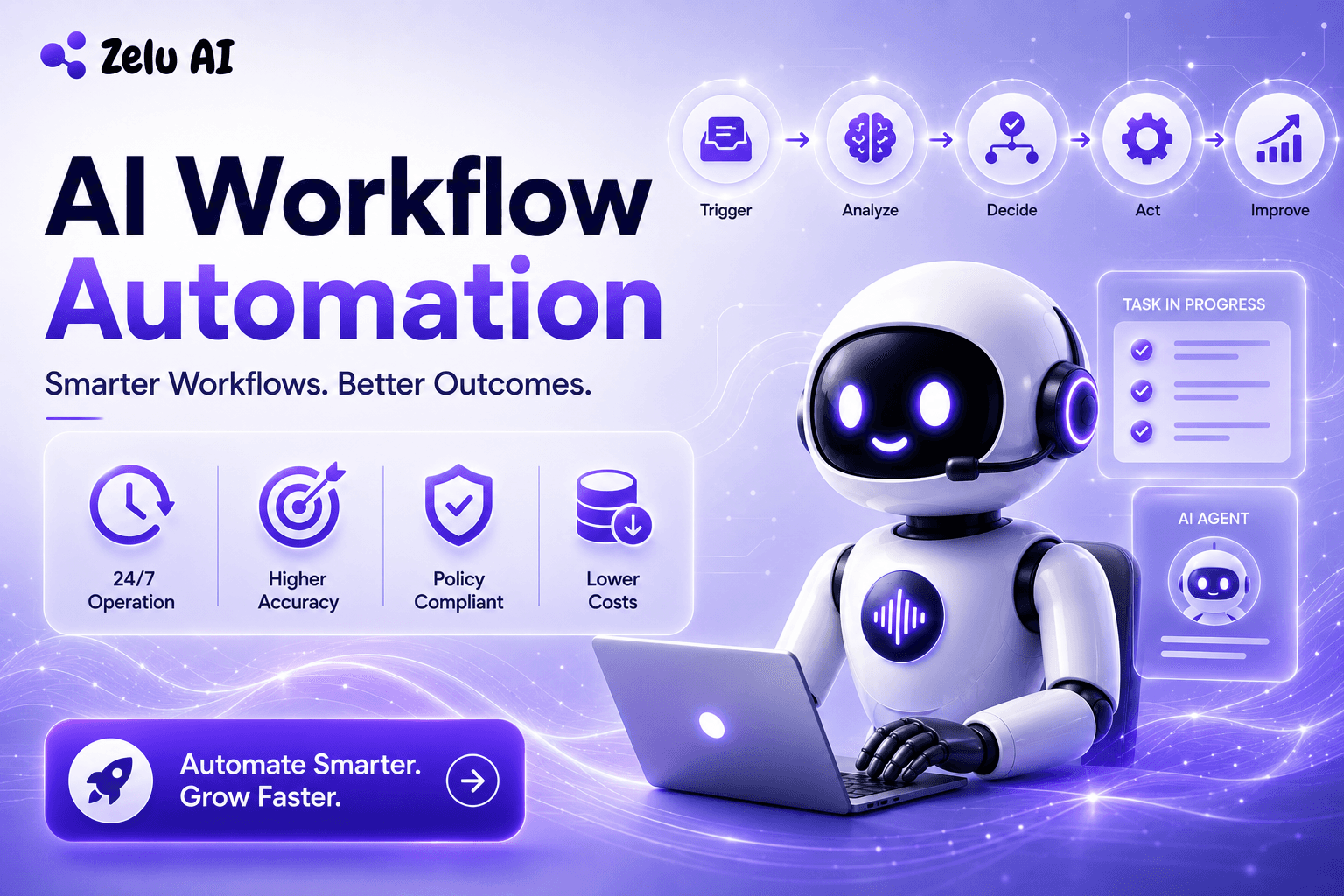
The five-step workflow cycle:
When a process is triggered an email arrives, a form is submitted, a deadline approaches—the AI agent immediately gathers relevant context from your company systems. It's not reading in isolation; it's pulling customer history, past interactions, company policies, and relevant data simultaneously.
The agent then analyzes this complete picture. It recognizes patterns matching previous successful cases. It evaluates different action options against your business objectives. It generates confidence scores for each potential decision, understanding when human judgment is essential.
Based on this analysis, the agent selects the optimal action. An invoice under approval limits matching purchase orders gets instant approval. A VIP customer with an urgent issue gets immediate escalation.
Every decision is documented with reasoning—your audit trail shows exactly why each action was chosen. The agent executes the decision autonomously. It creates records in your accounting system, sends notifications to the right people, routes to the next process step, or integrates with external systems.
Complete logging ensures compliance and visibility. For deeper understanding of how intelligent decision-making transforms business operations, explore our detailed guide.
Finally, the system tracks outcomes and learns. Did this decision produce good results? What patterns emerged? It adjusts future decisions based on evidence. Research from Deloitte shows organizations using self-learning automation achieve 35% faster performance improvement than static systems—improvement compounds continuously.
Real-world example in action:
When a customer submits a support ticket at midnight reporting critical account access issues, the AI agent immediately reads the full message, accesses complete account history, searches the knowledge base for similar issues, assesses urgency based on context and deadline, verifies customer legitimacy against company records, identifies VIP status, determines which support team has the best success rate with this issue type, and routes the ticket to the optimal person with complete context pre-loaded.
The customer receives an instant automated response promising resolution within 30 minutes. The assigned specialist gets the ticket with all necessary history already compiled. Traditional routing would require manual reading, thinking, and forwarding—easily taking hours. This efficiency compounds across thousands of daily interactions.
How Does AI Workflow Automation Improve Your Business?
The improvements materialize across five dimensions that directly impact operations and profitability.
Speed: Processing Cycles Compress Dramatically
Invoice processing shrinks from five days to two hours. Customer onboarding drops from ten days to two days. Approval workflows compress from two weeks to two days. AI agents work 24/7 without weekend or night delays.
They make decisions instantly rather than waiting for manager email responses. They gather information in parallel rather than sequentially.
The business implications are substantial. Finance teams close monthly books weeks earlier—accelerating decision-making. Customer service responds to inquiries in minutes instead of hours—improving satisfaction scores.
Sales teams move opportunities through approval stages faster—increasing velocity. Teams consistently report 50-80% cycle time reduction in their first automated processes.
Accuracy: Error Rates Drop Because Consistency Improves
Humans make mistakes on repetitive tasks. Fatigue causes typos. Shortcuts skip validation. Judgment varies between people. An AI agent applies identical logic every single time. Invoice processing error rates drop from 8-15% to under 1%.
Document classification accuracy jumps from 70% to 98%. Fewer errors mean less rework, lower total costs, and better regulatory compliance. For more on how consistency improves compliance outcomes, see our compliance automation guide.
Scalability: Growing Without Proportional Hiring
A team handling 500 requests monthly can now handle 5,000 requests with identical staffing. The AI agent never gets tired. It doesn't need vacation time. It handles seasonal spikes without temporary staffing.
Organizations can enter new markets or expand services without hiring proportionally. Your operational capacity scales independently of headcount growth.
Consistency: Policy Adherence Reaches 100%
Every customer receives identical treatment. Every decision follows the same rules. Audit trails show exactly why each decision was made. Regulatory compliance becomes straightforward because the workflow enforces policies automatically rather than relying on individual judgment. This consistency across thousands of decisions eliminates the variability that creates compliance risk.
Cost Reduction: Financial Impact Flows From Multiple Sources
Labor costs decrease when processes handle greater volume with existing staff. Error costs drop as rework diminishes. Efficiency gains free employee time for higher-value work. Organizations typically see 30-70% cost reduction in automated processes depending on process complexity.
Concrete example: A five-person finance team processing invoices often spends significant time on repetitive data entry, validation, and routing tasks. With AI workflow automation handling routine processing, the same team can process substantially higher volumes while maintaining greater accuracy and consistency. E
mployees can focus on vendor relationships, exception handling, and strategic spend analysis instead of manual administrative work. As automation expands across additional workflows, organizations benefit from faster processing times, fewer errors, improved scalability, and more productive teams.
Real-World Application: Finance Process Transformation
The current challenge: Invoices arrive through email, portals, and EDI systems in inconsistent formats. Finance staff manually open each one, search for matching purchase orders, code to the general ledger manually, and route for approval. This takes days. Discrepancies create delays. Errors require rework and create compliance concerns.
The AI workflow solution: The agent reads invoices automatically regardless of format or language, extracting vendor name, invoice amount, date, and line items accurately. It matches automatically to purchase orders already in the system.
It codes to the correct general ledger account using learned patterns from your historical data. For invoices under approval limits matching purchase orders exactly, it posts automatically and schedules payment.
Only when something deviates from normal does the agent escalate to a human. Unusual vendor names, high amounts, or discrepancies trigger human review—but with complete context already compiled.
Processing time drops from 3-5 days to 2 hours. Manual touches decrease from six steps to zero for routine invoices. Error rates plummet from 12% to 0.5%. This efficiency extends across your entire financial operation.
How to Begin Your AI Workflow Automation Journey
You don't need to overhaul your entire operation at once. Strategic implementation starts with identifying one high-impact process—something repetitive, time-consuming, error-prone, and high-volume.
First, document your current state. How long does this process take from start to finish? How many errors occur and what's the rework cost? What's the total cost—labor plus errors plus delays? These baseline metrics become your measurement standard.
Second, define your ideal future state. What should happen completely automatically? What decisions require human review? What guardrails and approval limits apply? This clarity ensures the AI operates within boundaries you're comfortable with.
Third, pilot the solution with real data while running the manual process in parallel. This eliminates business risk—if something goes wrong, you still have the manual process. Measure results against your baseline. If you achieve accuracy above 90% and time savings above 50%, you've proven the concept.
Most first processes go live in 8-10 weeks. The compounding benefit emerges over time. As your AI agents learn from outcomes, performance improves continuously without additional manual optimization. Your first automated process typically breaks even within 3 months.
Final Thoughts
AI workflow automation helps organizations eliminate repetitive work so employees can focus on strategy, customer relationships, and other high-value tasks, while AI agents handle routine processes around the clock.
Businesses that adopt business process automation strategically can gain a significant competitive advantage by proving ROI and scaling successful use cases. The opportunity is already here, and early adopters are moving fast.
Ready to see the impact? ZeluAI helps enterprises identify high-value automation opportunities and deploy AI workflow solutions that deliver measurable results.