Insights
/
feb 16, 2025
How AI Agents Differ from Traditional Chatbots
Discover how AI agents differ from chatbots. Learn why autonomy matters, spot fake agents, and decide which automation tool your business needs.
/
AUTHOR

Gracia Perkin
Your CEO saw an AI chatbot demo and asked if it could replace your support team. Your vendor called it an "AI agent." Is it actually autonomous? Or just a chatbot with a new name?
This confusion costs companies millions. Over 90% of organizations are investing in AI technologies, but most are confusing chatbots with AI agents. Only ~130 vendors out of thousands are verifiably agentic according to Gartner. Understanding the difference determines whether you solve problems or just answer questions.
What Exactly Is a Traditional Chatbot?
A chatbot is a conversational interface designed to communicate, not execute. It responds to user input but cannot act on business systems independently.
There are two types: rule-based chatbots that follow scripts and keyword matching, and LLM-powered chatbots that use large language models for more natural conversation.
Rule-based chatbots operate through predefined decision trees. A customer selects "1 for support, 2 for sales," triggering predetermined responses. They're reliable and cost-effective but rigid, they break when users go off-script.
LLM-powered chatbots sound more natural. They understand broader language patterns without extensive scripting. But here's the critical limitation: they still only generate responses. They cannot execute actions, make autonomous decisions, or complete multi-step processes independently.
What All Chatbots Share
Whether rule-based or LLM-powered, every chatbot has the same core characteristic: it responds, but doesn't act.
A chatbot can provide information, guide workflows, and escalate issues. What it cannot do is execute tasks across your business systems, make independent decisions, or complete complex problems end-to-end. That's the execution gap that defines chatbot limitations.
What Makes an AI Agent Fundamentally Different?
An AI agent is not an advanced chatbot. It's architecturally different. Gartner defines AI agents as "goal-driven software entities that use AI techniques to perceive, make decisions, take actions and achieve goals."
The core distinction isn't conversation ability, it's autonomy. An AI agent perceives information from your systems, reasons through complex scenarios, decides on the best action, and executes that action without constant human intervention. Most importantly: it closes the execution gap that chatbots create.
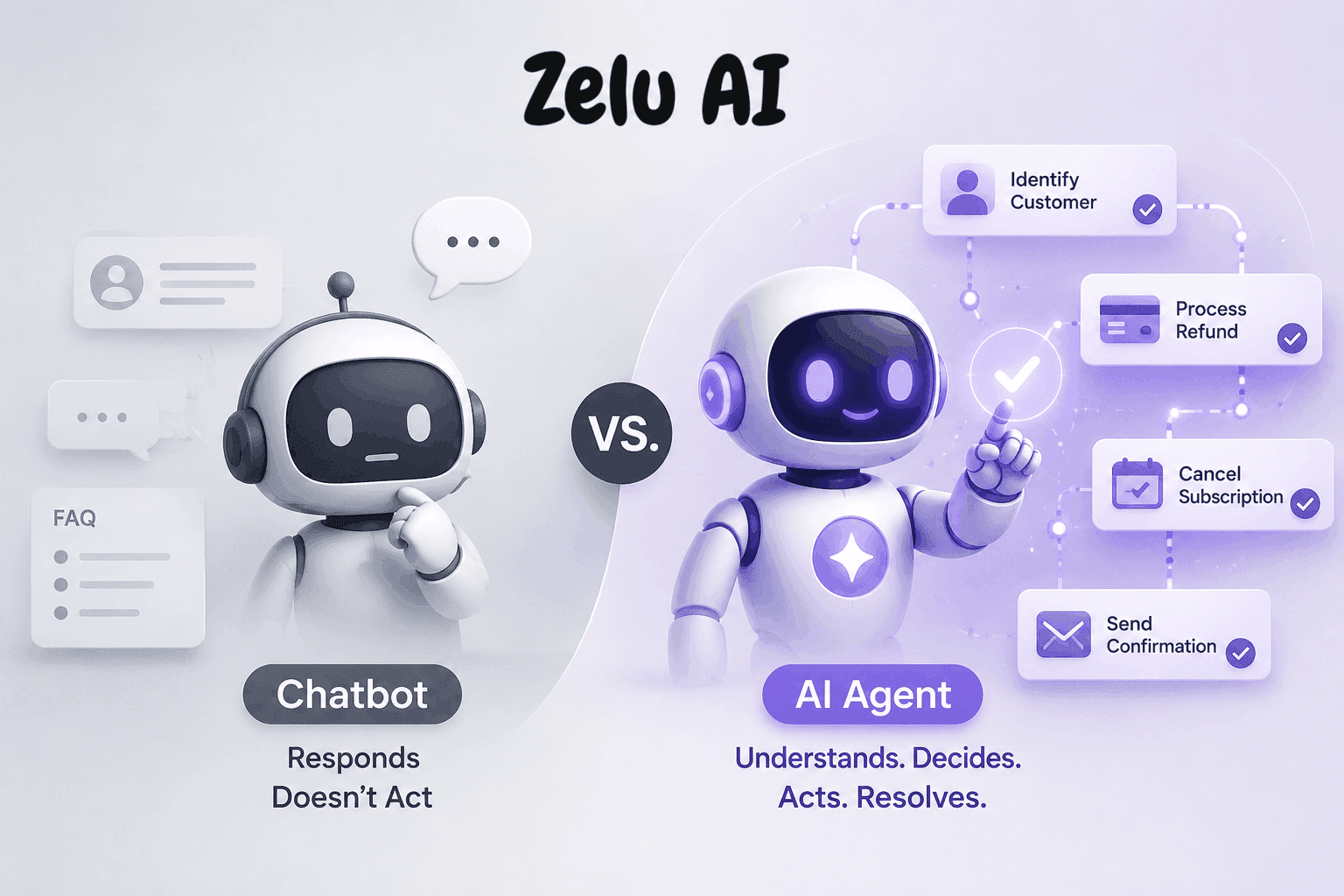
Consider a real example. A customer requests: "Cancel my subscription and refund what corresponds to this month."
A chatbot provides cancellation instructions and asks the customer to confirm. The human must complete the actions.
An AI agent identifies the customer, queries the subscription, calculates the refund amount, processes the cancellation, initiates the refund, and confirms the result to the customer. The task closes completely without human involvement.
The Core Categories That Separate Them: Purpose, Action, Execution, and Integration
Chatbots use keyword matching or basic language processing. AI agents understand full context across integrated systems, they know who the customer is, what product they're using, and what's been tried before.
Action: Chatbots cannot modify business systems. AI agents read, write, and modify data in your CRM, ticketing system, databases, and other tools.
Memory: Chatbots forget conversations after they end. AI agents maintain persistent customer history and learn from every interaction across all conversations.
Reasoning: Chatbots follow predetermined rules. AI agents use chain-of-thought reasoning to decompose complex requests into steps, deciding which tools to use and how to solve novel problems.
Learning: Chatbots remain static, improving only through manual updates. AI agents adapt automatically, improving their responses based on outcomes without human intervention.
How Do They Actually Differ in Practice?
A customer asks: "What's my order status?" A chatbot matches the keywords "order status," retrieves the FAQ, and returns generic information about tracking. The customer must navigate themselves.
An AI agent understands the specific customer, their recent order history, shipping delays, and whether they've had issues before. It provides personalized status, offers proactive solutions, and anticipates questions before they're asked.
This difference context determines whether you solve the actual problem or just answer the surface question.
To understand when customization matters, see our breakdown of custom AI agents vs off-the-shelf tools.
Execution Defines the Outcome
Customer problem: Password reset needed.
Chatbot response: "Here's how to reset your password. Follow these steps." The customer must execute.
AI agent response: Verifies identity, resets the password, sends confirmation email. Complete in seconds. Zero customer effort.
This is the execution gap. Chatbots create more work. AI agents eliminate it.
Memory Creates Continuity
Chatbots treat every conversation as new. A customer explains their issue, the chatbot asks follow-up questions they answered yesterday. Frustrating and inefficient.
AI agents remember customer history, previous resolutions, preferences, and patterns. They provide continuity and personalization that feels human-like.
Reasoning Handles Edge Cases
A customer requesting a refund outside the standard 30-day window with specific circumstances.
Chatbot: Only works for scenarios explicitly programmed. This situation has no predefined path. Escalate to humans.
AI agent: Reasons through the customer history, assesses risk, determines authority limits, and makes a judgment call within boundaries. Handles in seconds.
Learning Improves Over Time
Chatbots improve only when someone manually updates them. They plateau. AI agents get better with every interaction. They learn which approaches work, which fail, and adapt their future responses. Continuous improvement without manual intervention.
When Are Chatbots Actually the Right Choice?
Chatbots make sense for specific, high-volume, simple interactions. If you're handling frequently asked questions, appointment booking, password resets, or basic information gathering, chatbots are efficient and cost-effective.
Hotel chatbot: "What are your room rates?" → Chatbot provides current rates. Perfect use case.
E-commerce: "Where's my order?" → Chatbot shows tracking information. Works well.
Support: "How do I reset my password?" → Chatbot provides instructions. Appropriate.
The honest truth: Chatbots handle 60-70% of typical support volume effectively. They're fast, affordable, and scalable for repetitive work.
The Real Trade-Off
Chatbots require less setup and deploy faster. But they limit what you can automate. They excel at efficiency for simple tasks but fail at effectiveness for complex problems. Your choice depends on whether your interaction volume is primarily simple or mixed.
Where AI Agents Transform Your Operations
Every time a chatbot says "I can't help with that," it's hitting the execution gap. Every escalation to a human is a chatbot saying "this requires thinking and doing, which I cannot do."
AI agents bridge this gap. They handle the 30-40% of complex interactions that chatbots escalate every time.
Businesses looking to implement real AI agent workflows can explore solutions like ZeluAI, which focuses on building autonomous AI systems that execute tasks instead of just responding.
Multi-Step Complex Scenarios
Customer: "Cancel my subscription, refund this month, and switch me to a different plan."
Chatbot: Escalates all three actions to humans. Customer waits days.
AI agent: Executes all three immediately, updates systems, and confirms completion. Customer resolved in minutes.
Proactive vs. Reactive Behavior
A customer abandons their cart mid-checkout. A chatbot does nothing until that customer comes back and asks a question. An AI agent can notice the abandonment itself and act, no one needed to ask it to.
Context-Aware Personalization
Customer: "My shipment is late."
Chatbot: "Check your tracking page." Generic response. Customer frustrated.
AI agent: Reviews shipping partner status, proactively offers discount on next order, adjusts expectations based on history. The customer feels understood.
Measurable Business Impact
The numbers show the difference. Chatbots typically resolve a modest share of interactions on the first try. AI agents resolve considerably more. Chatbot escalation rates stay meaningfully higher, while agent escalation rates drop well below that. Customer satisfaction scores consistently run higher with agents than chatbots.
Over time, AI agents become more efficient despite requiring more effort upfront, since they reduce manual work, improve retention, and handle volume without additional hiring.
How to Spot Fake "AI Agents" (Agent-Washing)
The Truth About Vendor Claims
Not everything labeled "AI agent" is actually agentic. Many vendors call advanced chatbots "AI agents" to sound more sophisticated. This creates buyer confusion and wasted budgets.
Ask your vendor these five questions. If most answers include "we configured it for that," it's a chatbot:
Can it modify data in your systems without human approval? Real agents execute updates directly. Fake agents only suggest actions.
Can it complete multi-step tasks autonomously? Real agents decompose requests and execute end-to-end. Fake agents follow workflows you've configured.
Can it reason about novel problems? Real agents handle situations you didn't anticipate. Fake agents only work for scenarios you explicitly programmed.
Does it learn and improve automatically? Real agents improve from interactions. Fake agents improve when you manually update them.
Can it operate outside predefined paths? Real agents reason through unexpected situations. Fake agents get blocked when they hit the edges of their programming.
If all answers are "yes, autonomously," you've found a genuine AI agent. If most include "but we configured it," it's a chatbot wearing an agent label.
How to Decide: Chatbot, AI Agent, or Both?
Quick Assessment Questions
Is your interaction volume mostly simple and repetitive? Chatbots win.
Mix of simple and complex? Hybrid model wins (both working together).
Mostly complex, nuanced problems? AI agents needed.
Can you tolerate 30-40% escalation rates? Chatbots acceptable.
Need first-call resolution above 80%? AI agents required.
Do you need to execute actions in business systems? Chatbots can't. AI agents can.
The Winning Strategy
Most successful organizations use both. Chatbots handle high-volume simple requests. AI agents take complex cases. Escalation happens only for truly exceptional situations.
This hybrid approach requires less setup effort than pure agents, delivers far better outcomes than pure chatbots, and maximizes efficiency across your support operation.
Final Thoughts
Chatbots respond. AI agents resolve. The question isn't which technology is "better"—it's which solves your actual problems.
Chatbots are perfect for the 60-70% of queries that are genuinely simple. AI agents handle the 30-40% that require problem-solving, personalization, and action.
The companies winning in customer support aren't replacing agents, they're augmenting them. They're using chatbots for what they do well and AI agents for what chatbots can't do. Your decision should be based on your interaction complexity, not on hype.
FAQs
Is ChatGPT a chatbot or an AI agent?
It started as a chatbot, but newer versions with browsing and tool use show early agentic behavior, without being fully autonomous.
Can we gradually migrate from chatbots to AI agents without starting over?
Yes. Deploy agents alongside chatbots for complex issues while bots handle simple queries. Gradually shift more workload to agents as you optimize. Most companies transition over 6-12 months without disrupting existing operations.
What's the typical ROI timeline for switching from chatbots to AI agents?
Most organizations see positive ROI within 6-9 months when deployed for the right problems. Agents handle complex cases 85-95% autonomously vs. chatbots' 45-55%, reducing support headcount needs while improving customer satisfaction scores immediately.
Do AI agents require constant human monitoring and adjustments?
Less than chatbots. Agents self-improve through learning and adapt to new patterns automatically. You set guardrails and authority limits upfront, then agents operate with minimal intervention. Updates happen through feedback, not manual reconfiguration like chatbots.
What's the difference between an AI agent and RPA (Robotic Process Automation)?
RPA handles rigid, repetitive tasks following exact rules. AI agents handle complex, unpredictable situations requiring reasoning and adaptation. RPA is deterministic; agents are probabilistic. RPA works for data entry; agents work for nuanced customer problems that need decision-making.