نصائح
/
16 فبراير 2025
How to Track AI Search Sentiment & Improve Brand Perception
Learn how to monitor AI brand sentiment across ChatGPT, Perplexity & Gemini. Track endorsements vs neutral mentions, and improve position.
/
مؤلف

غرايسيا بيركين
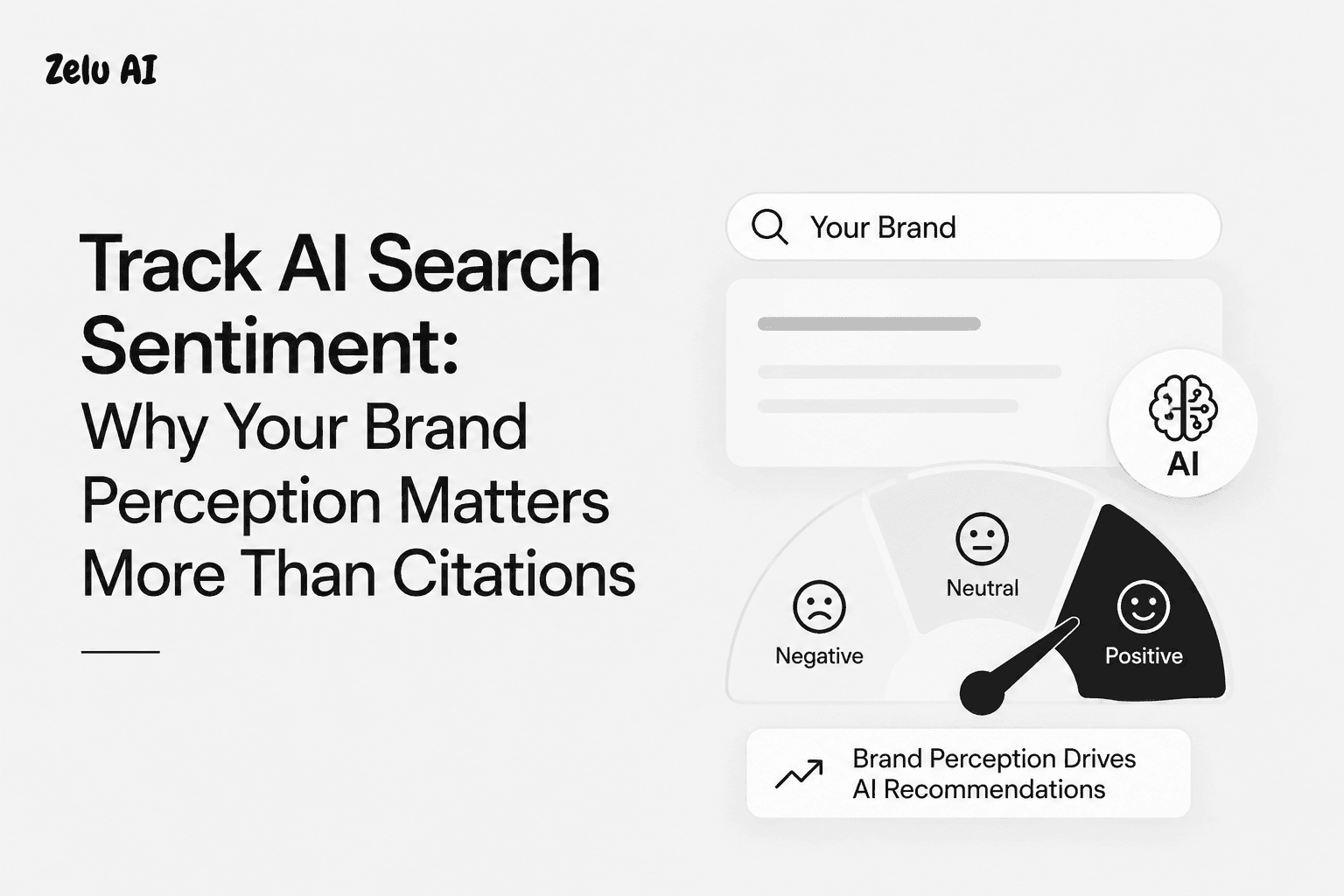
Right now, ChatGPT, Perplexity, and Google Gemini are talking about your brand. But here's what most companies don't realize: being mentioned isn't the goal. Being mentioned positively is.
When 73% of B2B buyers trust AI recommendations over traditional ads, the sentiment behind those mentions determines whether you win the sale, or lose it to competitors before prospects even visit your website. This shift represents a fundamental change in how brand reputation forms in the AI-powered search era.
Why Does Sentiment Matter More Than Getting Mentioned?
AI brand sentiment is fundamentally different from simple brand mentions. While being cited by AI platforms shows your content exists, sentiment reveals how AI describes your brand to potential customers. This distinction matters because AI doesn't just list options, it positions them with qualitative language that shapes buyer perception before they ever click.
Consider this: a brand mentioned in 60% of category prompts sounds impressive until you dig deeper. According to Visiblie's analysis of 200+ brands, only 28% of those mentions are actually endorsements.
The remaining breakdown is sobering: 41% are neutral descriptions, 19% are cautious hedges, and 12% are hallucinations. This means 72% of your mentions either don't help or actively hurt your conversion chances.
When ChatGPT describes your CRM as "available and offers features," compared to "the leading platform for enterprise teams," both are mentions. Only one drives conversions. This is why sentiment, not citation frequency predicts whether prospects will buy.
How Do AI Models Actually Decide What to Say About Your Brand?
Understanding how AI models form opinions about brands requires recognizing that they don't think like humans. Instead, they synthesize brand characterizations from multiple information sources, each with different update speeds and influence levels.
Training data
Training data represents the model's long-term memory. This massive corpus of text, news articles, reviews, documentation, forum discussions was ingested during initial training. For ChatGPT, this is the primary source. Once training completes, this data only updates when the model retrains, typically every few months. If negative information about your brand was published two years ago, it likely exists in ChatGPT's training data and won't disappear until the next major update.
Real-time retrieval (RAG)
Real-time retrieval is where things get interesting for brand managers. RAG based systems like Perplexity and Google Gemini don't just rely on training data. They actively search the current web when answering queries, pulling fresh information.
This means sentiment about your brand can shift week-to-week as new content gets indexed. A positive press release published today might influence Perplexity's description of you within days, while ChatGPT may not reflect it for months.
E-E-A-T signals
E-E-A-T signals (Experience, Expertise, Authoritativeness, Trustworthiness) directly influence how favorably AI models characterize you. Consistent brand information across sources builds trust.
Ready to strengthen your E-E-A-T signals and improve AI sentiment? Discover how Zelu AI can help
Authoritative publications mentioning your brand signal expertise. Clear entity definitions through schema markup help AI understand your claims. Brands with strong E-E-A-T get endorsement language; those with weak signals get hedging like "some users report" or "may be suitable for."
Platform differences matter significantly
ChatGPT, built on historical data, reflects sentiment from established sources. Perplexity's real-time retrieval means current web content dominates. Gemini integrates Google's entity understanding from Search, Maps, and Reviews. Claude relies on training data with constitutional AI filtering affecting tone. The same brand receives different sentiment treatment across these platforms because they weight information sources differently.
What Metrics Should You Actually Track?
AI sentiment tracking: requires measuring specific dimensions that capture how models characterize your brand, not just whether they mention you.
Mention frequency is your baseline. Calculate it as: (responses mentioning your brand) / (total category responses) = %. A 60% mention rate means your brand appears in most category conversations—excellent baseline visibility.
Sentiment distribution reveals the real story. Of those 60 mentions, classify each as endorsement ("leading," "top choice"), neutral ("offers features like"), cautious ("may be suitable"), negative ("lacks compared to"), or hallucination (false facts). If your 60 mentions break down as 12 endorsements, 25 neutral, 15 cautious, and 8 negative, your actual positive positioning is 12/60 = 20% not 60%.
Net Sentiment Score (NSS) provides a single number to track monthly. The formula is: (Endorsement + Neutral - Negative - Hallucination) / Total × 100. Using the previous example: (12 + 25 - 8 - 3) / 60 × 100 = +43 NSS. This ranges from -100 (entirely negative) to +100 (entirely positive). Benchmark interpretation: +60+ indicates strong positioning; +20-59 is acceptable with room for improvement; -19 to +19 signals mixed perception; below -20 requires immediate action.
Share of voice shows your competitive standing. Even if your mention rate is 40%, if competitors capture 80% of positive sentiment, you're losing positioning battles. Track this sentiment-weighted metric monthly to spot declining competitive advantage.
How to Monitor AI Brand Sentiment Without Expensive Tools
A simple DIY method can help you track how AI platforms perceive your brand without investing in costly software.
Identify Real Customer Prompts
Start by listing 10–15 prompts your target audience is likely to ask AI tools. For example, in the CRM space, users may search for “best CRM for startups,” “affordable CRM alternatives,” or “CRM with easiest implementation.”
Test Across Multiple AI Platforms
Run these prompts in ChatGPT, Perplexity, and Google Gemini using incognito mode to get unbiased results. Since AI responses can vary, test each prompt 2–3 times to distinguish consistent patterns from random outputs.
Classify Brand Sentiment
For every mention of your brand, assign a sentiment score using a five-point scale: endorsement, neutral, cautious, negative, or hallucination. Also, note how your brand is positioned compared to competitors and highlight any factual inaccuracies.
Measure Sentiment Performance
Calculate your overall sentiment distribution and Net Sentiment Score (NSS). Then, benchmark these results against competitors using the same evaluation method.
Track Changes Over Time
Repeat this process monthly. Monitor whether your NSS improves or declines, identify strong vs weak prompts, and uncover emerging trends in AI perception.
When to Upgrade Tools
This DIY method is cost-effective and insightful. However, if tracking exceeds 4 hours per month, consider tools like Peec AI or OtterlyAI to automate the process while maintaining accuracy.
What Your Sentiment Results Reveal About Strategy?
AI sentiment insights highlight specific weaknesses and opportunities in your brand positioning.
High Endorsement Signals Market Strength
If your brand receives frequent endorsements, it indicates strong authority. Maintain your current strategy and expand into related categories where your presence is still limited.
Visibility Without Trust
If your brand appears often but lacks endorsements, it suggests low trust. Identify the causes—pricing, features, or positioning—and create targeted content to address these concerns directly.
Missing High-Intent Opportunities
Low visibility in high-intent prompts means you’re absent from critical buying-stage conversations. Focus on publishing detailed guides that address these use cases and clearly position your brand against alternatives.
Fixing Hallucinations and Errors
Incorrect or outdated information requires immediate action. Update the source content and implement structured data (schema markup) to ensure AI tools retrieve accurate information.
Platform-Specific Differences
AI platforms rely on different data sources. ChatGPT favors authoritative mentions, Perplexity prioritizes fresh ranking content, and Gemini leans on Google’s ecosystem signals like reviews and Knowledge Graph data. Your strategy should adapt accordingly.
How to Improve Your AI Sentiment Strategically?
Closing sentiment gaps requires a focused and data-driven content approach.
Address Topic Gaps
If AI doesn’t associate your brand with certain strengths, create content that fills those gaps. For example, publish guides like “Implementation in 48 Hours” with real-world case studies and technical details.
Build Authority Signals
If your mentions come from weak sources, strengthen credibility through placements in high-authority platforms like Gartner, Forrester, or industry-specific review sites.
Focus on High-Impact Content Types
Certain formats perform better in AI citations, including original research, in-depth guides, comparison articles, and case studies. These provide reliable information AI models can confidently reference.
Use a Continuous Feedback Loop
Identify your biggest sentiment gap, create targeted content, wait 2–4 weeks for indexing, then re-evaluate sentiment on the same prompts. Repeat this cycle to drive consistent improvement.
Building a Sustainable Sentiment Tracking System
Building a sustainable sentiment tracking system requires consistency to ensure it remains actionable and scalable over time. This starts with weekly monitoring, where you spend 15–30 minutes reviewing your top three prompts to quickly spot any sudden changes.
On a monthly basis, conduct a more detailed analysis across all prompts and platforms, dedicating 2–3 hours to gather deeper strategic insights. Every quarter, perform a performance review by connecting sentiment trends with actual business outcomes, assessing whether improvements are leading to higher conversions.
Finally, integrate sentiment tracking with your broader strategy by aligning it with SEO, PR, and product development, since the same content often influences both search rankings and how AI platforms perceive your brand.
The Bottom Line
Success in AI search isn’t just about rankings it’s about perception. Brands that are consistently described as trusted, innovative, and reliable outperform competitors. AI sentiment directly influences conversions, and unlike traditional SEO signals, it can be actively monitored and improved.
Start now: define your core prompts, run your first audit, and build a system that gives you a lasting competitive edge.
FAQs
What's the difference between AI citations and AI brand sentiment?
Citations are links AI provides as supporting evidence for its answer. Sentiment is how AI describes your brand, the tone and positioning it uses when recommending you. Citations show your content exists; sentiment determines whether prospects trust your brand enough to buy.
How often should I track my AI sentiment?
Run weekly spot-checks on your top 3 prompts (15-30 minutes) to catch major shifts early, and complete monthly audits across all prompts and platforms (2-3 hours) for strategic insights and trend analysis.
Can I improve AI sentiment without publishing new content?
Partially, but content is the primary lever. You can fix hallucinations by updating existing pages and adding schema markup, but moving from cautious to endorsement sentiment typically requires new, authoritative content addressing the gaps AI identified.
Which AI platform should I prioritize tracking first?
Start with ChatGPT (77-80% of AI traffic volume) and Perplexity (15-20%, heavily used by B2B researchers). Add Gemini once you've optimized for these two, since it captures lower traffic but is growing rapidly.
Does Google ranking affect my AI sentiment score?
Not directly. You can rank #1 on Google but receive cautious sentiment in ChatGPT if your content doesn't emphasize the right capabilities. Rank #5 on Google but get endorsed in AI if your content clearly demonstrates expertise. Track both separately, they require different optimization strategies.