نصائح
/
16 فبراير 2025
Agentic AI vs Generative AI: Key Differences Explained
Generative AI creates. Agentic AI acts. Discover the real differences between both, how they work, and which one your business actually needs.
/
مؤلف

غرايسيا بيركين
If you have been following the AI space lately, you have probably heard both terms thrown around, sometimes even interchangeably. But agentic AI and generative AI are not the same thing, and confusing the two could mean choosing the wrong tool for your business.
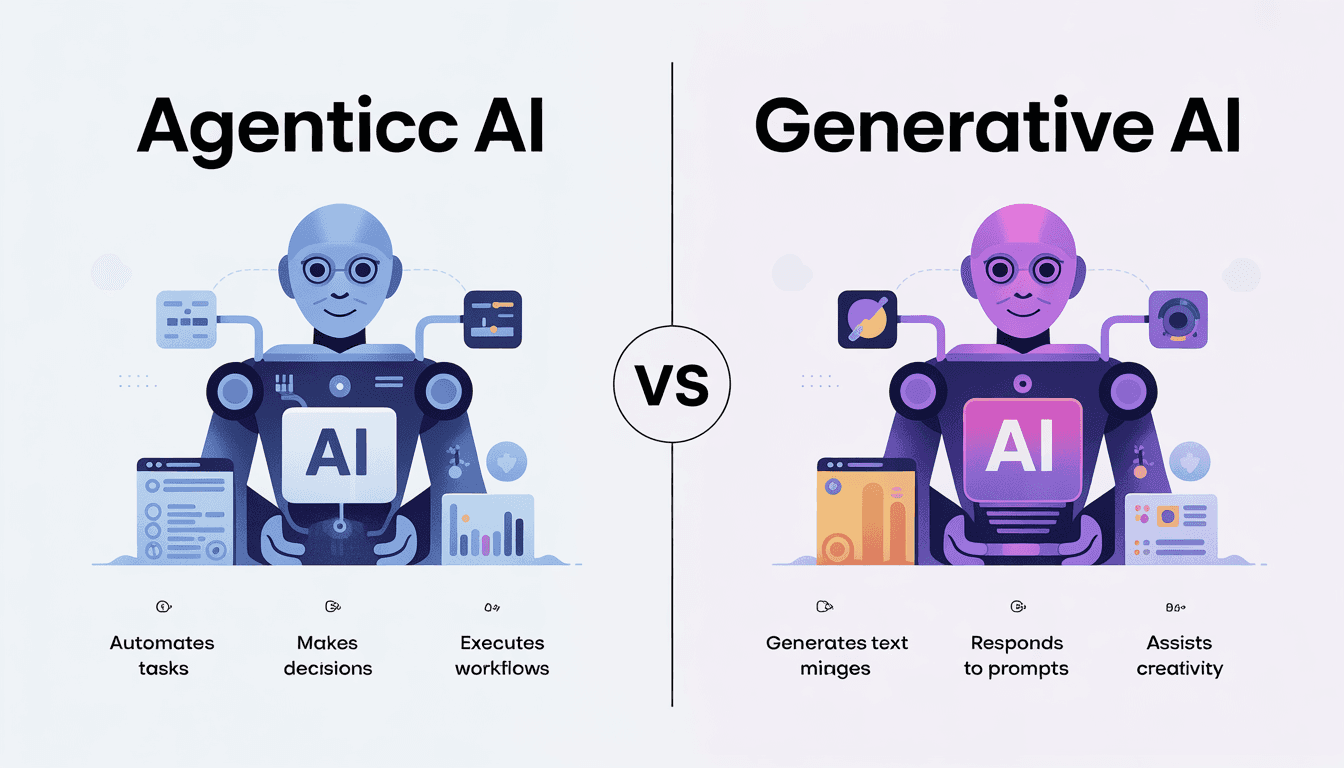
Here is the simplest way to think about it: generative AI creates, agentic AI acts. One writes the email. The other writes it, sends it, schedules the follow-up meeting, and updates your CRM, without being asked twice.
That one distinction changes everything about how these systems are built, what they cost, and where they actually deliver value. This guide breaks it all down clearly so you can make the right call for your team.
What Is the Difference Between Agentic AI and Generative AI?
At the surface level, both agentic AI and generative AI are powered by large language models (LLMs). They both use natural language processing to understand and respond to human input. That is where the similarity ends.
Generative AI is reactive. It waits for a prompt, produces an output, and stops. It has no awareness of what happened before the conversation or what needs to happen next. It simply responds.
Agentic AI is proactive. It takes a goal, breaks it into steps, figures out what tools it needs, executes those steps in sequence, checks its own results, and keeps going until the job is done. It does not need you to hold its hand at every stage.
Think of it this way: generative AI is a brilliant freelancer you have to brief every single time. Agentic AI is more like a reliable employee who takes a target, builds the plan, and delivers the result.
Is Agentic AI Built on Top of Generative AI?
Yes, and this is an important nuance most comparisons miss. Agentic AI does not replace generative AI. It uses it.
The LLM inside an agentic system acts as the cognitive engine, it does the reasoning, language understanding, and content generation.
But the agentic layer wraps around it with memory, planning, tool access, and the ability to loop through tasks until a goal is reached. So generative AI is the brain. Agentic AI is the brain plus hands, legs, and a to-do list.
How Does Generative AI Work?
Generative AI learns from massive datasets, books, articles, code, images and identifies patterns in that data. When you give it a prompt, it uses deep learning models to predict the most statistically likely output based on everything it has learned.
It is extremely good at creation. Text, images, audio, video, software code generative AI can produce all of it, often in seconds, and at a quality that would take a human hours.
The key thing to understand is that generative AI has no persistent goals. It does not know what you did yesterday, what you are trying to achieve this quarter, or what the next step is after the output it just gave you. Each prompt is a fresh start.
What Are Some Real-World Examples of Generative AI?
You are probably already using generative AI without thinking much about it. ChatGPT drafts emails, answers questions, and writes code. GitHub Copilot suggests entire functions as you type.
Midjourney generates detailed images from a text description. Sora creates video clips from prompts. These are all generative AI tools brilliant at creating content, but completely dependent on your input to do anything.
What Are the Limitations of Generative AI?
The most well-known limitation is hallucination, generative AI can produce outputs that sound completely confident but are factually wrong. The quality of the output also depends heavily on how well you write your prompt.
Beyond that, generative AI cannot take action on its own. It will write a brilliant sales email but cannot send it. It will draft a project plan but cannot assign the tasks. For anything that requires multi-step execution in the real world, you hit a wall quickly.
How Does Agentic AI Work?
Agentic AI operates through a continuous loop that most people describe in four stages: perceive, reason, act, and learn.
First, it takes in information about your goal, the tools available, past context, live data. Then it reasons through the best path forward, often breaking a complex objective into smaller sub-tasks.
Then it acts by calling APIs, searching the web, writing content, sending messages, updating databases. Then it reviews the outcome and adjusts before moving to the next step.
This loop runs repeatedly until the goal is achieved or it hits a constraint you have set. That is what makes agentic AI fundamentally different, it does not just respond, it executes.
Unlike generative AI, which performs inference once per prompt, agentic AI runs the inference loop over and over across a multi-step workflow. This is also why agentic systems are more complex to build and maintain.
What Are Some Real-World Examples of Agentic AI?
OpenAI's Operator can navigate websites and complete tasks on your behalf. Salesforce's Einstein Copilot answers customer questions, sends reminders, and books meetings automatically.
Agentic AI systems in healthcare can monitor patient data, flag anomalies, and trigger care protocols, all without waiting for a nurse to prompt them.
At ZeluAI, we build custom AI agents that handle entire business workflows from lead capture and qualification to customer support and operations, so your team can focus on work that actually requires human judgment.
What Are the Limitations of Agentic AI?
Agentic AI is significantly more complex to deploy than generative AI. It requires orchestration layers, memory management, tool integrations, access controls, and continuous monitoring. If something goes wrong mid-task, it can be harder to catch and correct than a single bad output from a generative model.
There is also a fundamentally different kind of risk at play. Generative AI's risk is informational, a hallucinated fact or a biased output.
Agentic AI's risk is operational, a wrong action taken on a live system nobody's watching closely enough. The more independently an AI system operates, the more important it becomes to define what it can and cannot do.
What Are the Key Differences Between Agentic AI and Generative AI?
Now that both are clearly defined, here is where they diverge in practice, the differences that actually matter when you are deciding which technology fits your use case.
How Do They Differ in Autonomy and Decision-Making?
This is the most fundamental difference. Generative AI makes zero autonomous decisions. It produces outputs and hands control back to you immediately. You decide what to do with it.
Agentic AI evaluates situations, weighs options, chooses a course of action, and executes, all on its own. It can even course-correct mid-task if the initial approach is not working. This is what gives agentic AI its power, and also what makes it require more careful deployment.
How Do They Differ in Goal Orientation?
Generative AI completes one task at a time. Give it a prompt, it gives you an output. There is no broader objective it is working toward, each interaction is self-contained.
Agentic AI is always working toward a defined goal. Every decision, every tool call, every output it generates is a step in a longer sequence. It understands context across the entire workflow, not just the current moment.
How Do They Differ in Memory and Context?
Standard generative AI has no memory between sessions. Tomorrow, it does not know what you discussed today unless you paste the conversation back in. This makes it difficult to use for ongoing, multi-session tasks.
Agentic AI systems are typically built with persistent memory, they remember past actions, past outcomes, and user preferences. This is what allows them to manage long-running workflows and adapt their approach over time.
How Do They Differ in Workflow and Execution?
The generative AI workflow is simple: prompt → output → human takes action.
The agentic AI workflow is a loop: goal → planning → task breakdown → tool execution → verification → repeat until done.
This means agentic AI can replace entire human workflows, not just assist with individual tasks. It does not need a person in the loop at every step.
What Are the Best Use Cases for Generative AI vs Agentic AI?
Both technologies deliver real value, but in very different situations, and they're only two points on a broader spectrum that also includes simpler rule-based automation, which still has its place for tasks that don't need this level of reasoning at all.
The mistake most businesses make is trying to use generative AI where they actually need agentic AI, or building complex agentic systems for problems a simple prompt could solve.
Generative AI is the right choice when the task is creative, bounded, and review-ready. Writing blog posts, summarizing reports, generating images, drafting code, producing product descriptions, these are all tasks where a human reviews the output before it goes anywhere. Generative AI excels here.
Agentic AI is the right choice when the task has multiple steps, requires live data, involves external systems, or needs to run repeatedly without human intervention.
Customer support automation, lead qualification, invoice processing, IT monitoring, and research pipelines are all places where agentic AI delivers far more value than a prompt-based tool ever could.
Can Generative AI and Agentic AI Work Together?
Absolutely, and in most real-world deployments, they already do. An agentic system will use a generative model to draft the customer email, then use its action layer to send it, log the interaction in your CRM, and schedule a follow-up. The generative AI handles the content. The agentic layer handles the execution.
This mirrors how McKinsey frames the shift: generative AI gave businesses a new way to create at scale, and agentic AI extends that into a new way to operate at scale.
Which AI Is Right for Your Business Agentic or Generative?
This is the question that matters most, and the honest answer is: it depends on what you are trying to automate.
If you are looking to speed up content production, assist your team with writing and research, or generate assets faster, generative AI is where you should start. It requires less setup, easier to deploy, and delivers clear, measurable value quickly.
If you are looking to remove humans from repetitive multi-step processes, build AI systems that operate around the clock, or automate decision-heavy workflows, agentic AI is what you need.
Adoption is still early but accelerating fast: only about 19% of enterprises have begun deploying agentic AI, though roughly 68% plan to invest within the next two years. 3M is one concrete example, using agentic systems internally to drive efficiency across its R&D operations.
Which Industries Benefit Most From Each?
Generative AI is already transforming marketing, e-commerce, software development, education, and media. Anywhere that produces high volumes of written, visual, or coded content sees an immediate return.
Agentic AI is making the biggest impact in customer service, healthcare operations, legal intake, financial risk management, supply chain coordination, and IT ops. These are all domains where multi-step decision-making used to require a human at every turn.
The decision does not have to be either/or. Most businesses that are serious about AI in 2026 are running both, generative AI for content and creativity, agentic AI for operations and automation.
Conclusion
Generative AI and agentic AI are not rivals, they are different layers of the same technological evolution. Generative AI gave us the ability to create at a scale and speed that was previously impossible. Agentic AI takes that further by giving AI the ability to actually get things done.
If your business is still figuring out where to start with AI, generative tools are the right entry point. If you are ready to automate full workflows and build systems that operate independently, agentic AI is where the real leverage is.
At ZeluAI, we specialize in building custom AI agents tailored to your exact business processes, not off-the-shelf tools, but intelligent automation designed around how you actually work. Explore our AI agent solutions or book a free strategy call to see what is possible for your team.
FAQs
Is ChatGPT Generative AI or Agentic AI?
ChatGPT began as generative AI, producing responses from prompts. New features like browsing and tools show early agentic behavior but are not fully autonomous.
Can Generative AI Become Agentic AI?
Yes, by adding memory, planning, and tool use, generative models can power agentic systems. The core model stays the same, but the surrounding architecture evolves.
Is Agentic AI More Risky Than Generative AI?
Yes, because it can take real actions like sending emails or triggering workflows. Mistakes can have real consequences, so guardrails are essential.
What Is the Future of Agentic AI?
Agentic AI is rapidly evolving into multi-agent systems handling complex tasks. It’s expected to become a core part of business operations across industries.