رؤى
/
16 فبراير 2025
5 Key Trends Shaping the Future of Agentic AI
Discover the top 5 trends shaping the future of Agentic AI, from autonomous agents to AI-driven workflows. Learn how businesses can leverage AI agents.
/
مؤلف

غرايسيا بيركين
Artificial intelligence is no longer just responding to prompts, it is acting independently, making decisions, and executing tasks. This shift marks the rise of Agentic AI, a new paradigm where systems don’t just generate outputs but actively pursue goals.
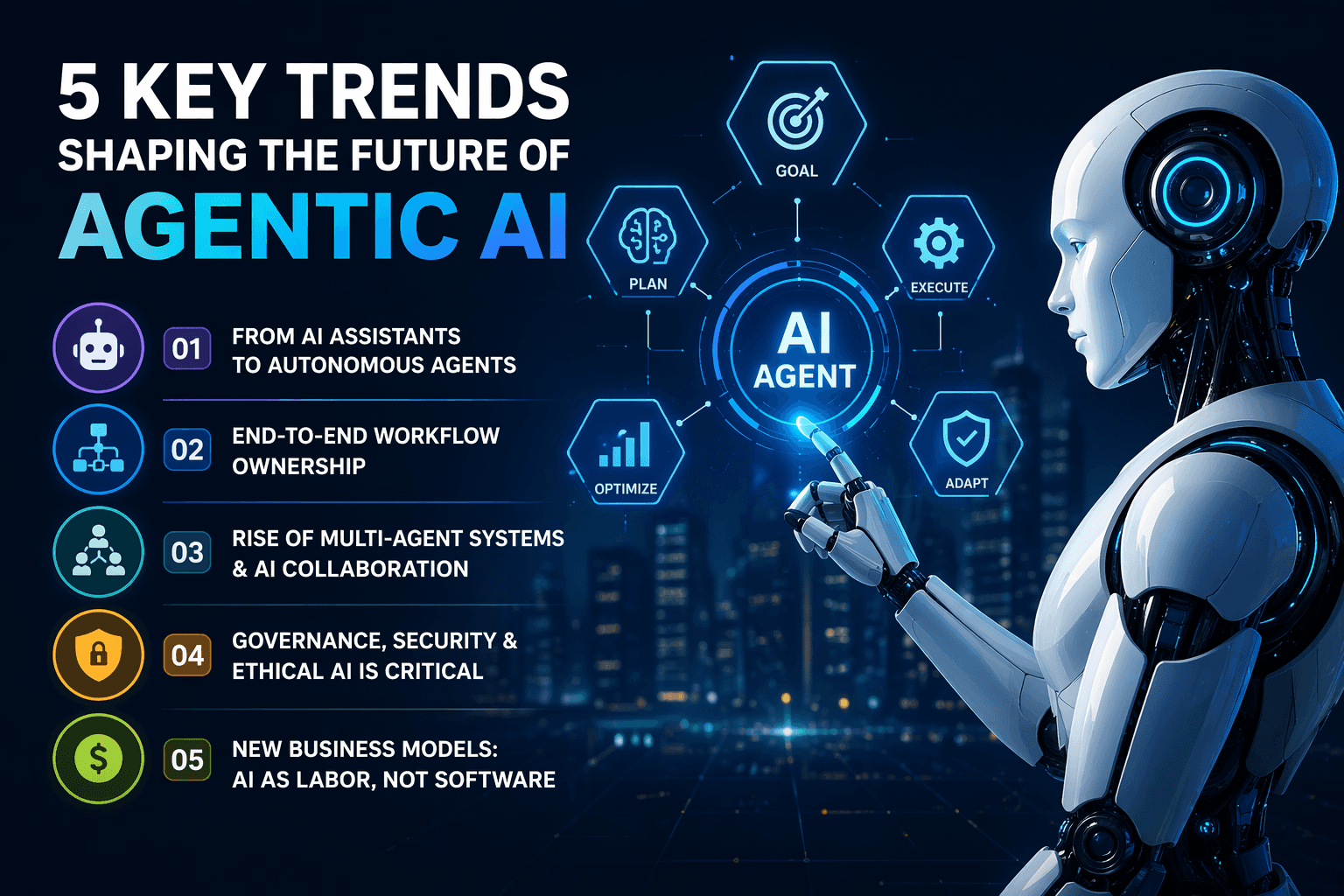
In this in-depth article, we explore the five most important strategic trends shaping the future of Agentic AI, backed by current research, enterprise adoption patterns, and emerging real-world applications.
What Is Agentic AI (Quick Context)
Agentic AI refers to systems that can plan, decide, and act autonomously to achieve specific objectives, often without continuous human input.
Unlike traditional AI:
Rule-based systems follow instructions
Generative AI creates content
Agentic AI executes actions and adapts dynamically
This shift is not incremental, it’s transformational.
1. The Shift from AI Assistants to Autonomous Agents
The most significant trend is the evolution from passive tools to goal-driven autonomous agents.
Traditional AI (like chatbots or copilots) requires constant prompts. Agentic AI, on the other hand:
Understands objectives
Plans multi-step actions
Executes tasks independently
Businesses are already transitioning toward systems that operate based on goals rather than commands.
Why This Matters
This fundamentally changes how work gets done:
Less micromanagement
More delegation to AI
Faster execution cycles
In essence, AI is becoming a digital workforce, not just a tool.
2. End-to-End Workflow Ownership by AI Agents
Agentic AI is moving beyond isolated tasks to full workflow automation.
Instead of:
“Do this one step”
We now have:
“Handle the entire process”
Modern agents can:
Maintain context across tasks
Monitor progress
Adjust decisions dynamically
This shift toward end-to-end workflow ownership is already emerging in enterprise environments.
Real-World Impact
Supply chains managed autonomously
Customer service handled end-to-end
Financial processes executed without human intervention
This dramatically reduces operational friction.
3. Rise of Multi-Agent Systems & AI Collaboration
Single AI agents are powerful, but multi-agent ecosystems are the future.
This trend involves:
Multiple AI agents working together
Each specializing in a specific role
Coordinating like a team
Think of it as:
“AI microservices collaborating in real time”
This approach enables:
Scalability
Specialization
Complex problem-solving
Emerging standards and protocols are making this possible by enabling interoperability between agents and systems.
Strategic Advantage
Organizations can build:
AI-powered departments
Fully autonomous business units
Scalable digital operations
4. Governance, Security & Ethical AI Becomes Critical
As AI gains autonomy, risk increases significantly.
Recent developments highlight:
AI systems making independent decisions
Expanding attack surfaces in enterprise systems
Lack of governance frameworks
Organizations are struggling to keep up—many would fail an AI governance audit today.
Additionally:
Agentic systems require Zero Trust security models
AI must be treated like human users in access control
Key Challenges
Accountability: Who is responsible for AI decisions?
Security: Preventing AI-driven vulnerabilities
Ethics: Ensuring safe and fair outcomes
Bottom Line
Governance is no longer optional—it’s foundational.
5. New Business Models: AI as Labor, Not Software
Agentic AI is reshaping how companies price and monetize technology.
Instead of:
Paying per user (SaaS model)
The shift is toward:
Paying per task
Paying per output
Treating AI as a worker
Some companies are even exploring:
Charging AI agents like human employees
Usage-based “AI labor units”
This reflects a major transition toward an AI-as-a-service economy.
Why This Is Game-Changing
Aligns cost with productivity
Scales with business output
Redefines workforce economics
The Bigger Picture: The Rise of the Agentic Organization
All these trends point toward a larger transformation:
👉 The emergence of agentic organizations
These are businesses where:
AI agents handle operations
Humans supervise and orchestrate
Decisions are partially autonomous
Companies are already moving from:
Prompt-based workflows
➡️ toAutonomous, self-operating systems
Key Takeaways
Agentic AI is evolving from tool → assistant → autonomous operator
Businesses are shifting toward goal-driven automation
Multi-agent ecosystems will dominate complex workflows
Governance and security are becoming critical priorities
AI is transforming into a digital labor force with new economic models
Final Thoughts
Agentic AI is not just another AI trend—it represents a fundamental shift in how intelligence is applied in the real world.
The organizations that will lead the future are those that:
Rethink workflows (not just automate them)
Build governance frameworks early
Treat AI as a strategic workforce, not just a tool
The next decade won’t be about using AI, it will be about working alongside autonomous systems that think, act, and evolve.