استراتيجية الذكاء الاصطناعي
/
16 فبراير 2025
AI Agents vs. BPO: Why AI Is Winning in 2026
AI agents outperform traditional BPO on quality, speed, and operational efficiency. Discover why enterprises are switching.
/
مؤلف

غرايسيا بيركين
Your company just renewed a BPO contract. Six months in, a competitor deploys AI agents and dramatically reduces their support expenses. They're now delivering better service while spending significantly less. You're locked in.
This scenario is happening across industries right now. The business process outsourcing model that worked for 20 years is being disrupted by intelligent automation. And if you're still negotiating BPO renewals in 2026, you're likely not getting the value you deserve.
The question isn't whether AI will replace traditional BPO. It's already happening. The real question is how quickly you can adapt.
What's Wrong with the Traditional BPO Model Today?
The offshore outsourcing promise was simple: move repetitive work to lower-cost regions and achieve significant operational savings. It worked brilliantly when labor arbitrage was the only metric that mattered. But customer expectations have changed. Business processes have become more complex. And wage inflation in traditional BPO hubs has eroded the original advantage.
Hidden Expenses Beyond the Contract
The real challenge with traditional BPO extends beyond what appears in your invoice. There are numerous hidden expenses that compound over time. When you factor in management overhead, employee turnover, quality assurance staffing, and continuous training requirements, the true operational burden becomes substantially higher than the base contract amount suggests.
Then there's the quality problem. With persistent annual agent attrition, your BPO team is constantly onboarding new people. Each new agent requires weeks to reach baseline competency. During that ramp period, resolution quality suffers, handle times increase, and customer satisfaction scores decline.
The Complexity Challenge
The traditional model also struggles with complexity. When customers reach out with problems that don't fit predefined workflows, they hit a dead end. They're escalated, transferred, or forced to repeat their issue multiple times. Studies show that BPO environments achieve only moderate first-call resolution rates meaning a significant portion of your customers need to reach out again.
How Much Can AI Save Compared to Traditional BPO?
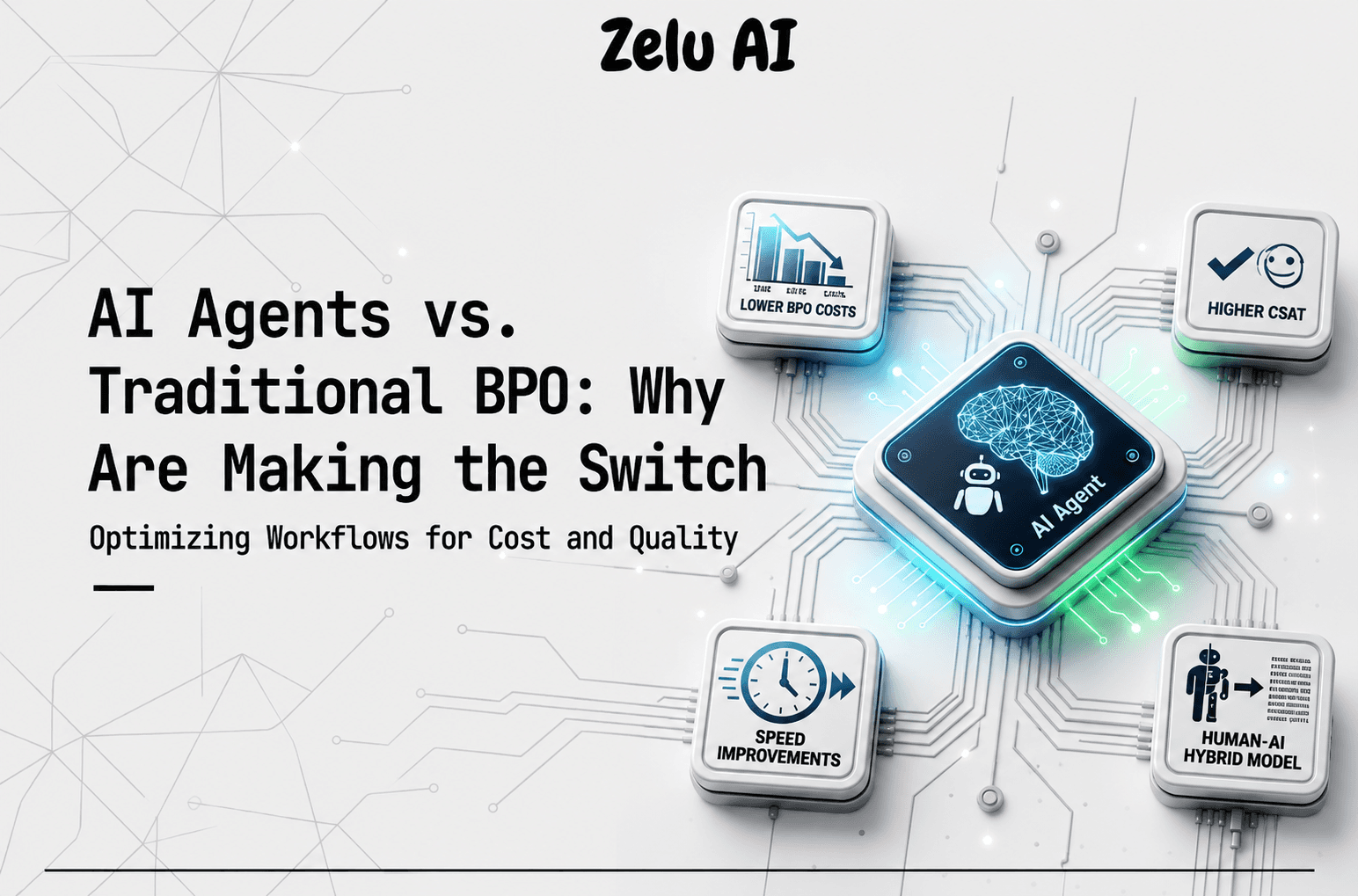
The financial comparison between AI agents and traditional BPO shows a significant difference in operational efficiency. Our AI agents deliver value at a substantially lower operational cost compared to human BPO agents. This advantage compounds as your interaction volume increases, creating exponential savings at scale.
But per-interaction efficiency tells only part of the story. Consider how the economics play out over time for a typical mid-market company handling high volumes of customer support interactions.
The Full Operational Picture
With traditional BPO, you're managing agent labor, management overhead, quality assurance, and escalation handling. All these elements contribute to your overall operational burden. By comparison, AI agent platforms operate on fundamentally different economics—software doesn't require the same management structure, training cycles, or staffing adjustments.
The real breakthrough emerges when you look at cost trajectory. Traditional BPO expenses typically increase annually due to wage inflation and market pressures.
AI operating expenses, by contrast, tend to decline over time as the system resolves more types of requests and improves from each interaction. By year three, the financial difference becomes substantial.
Over a multi-year period, the cumulative savings from switching to AI agents represents a meaningful improvement to your operational budget savings that can be redirected toward product development, sales growth, or customer experience enhancements.
Why Is AI Outperforming BPO on Quality Metrics?
First-Call Resolution: The Customer Experience Metric
Cost advantage alone wouldn't drive the shift toward AI. The real win is performance. AI agents are delivering better customer experiences while operating more efficiently.
First-call resolution rates tell the story. BPO environments achieve moderate resolution rates on first contact. Customers resolve their issues with AI agents at substantially higher rates. This happens because AI agents have instant access to all knowledge, can execute workflows end-to-end, and don't need supervisor approval for routine decisions.
Speed and Efficiency Improvements
Average handle time drops dramatically when you switch to AI. Traditional BPO agents work at human speed gathering information, typing responses, and navigating systems. AI agents operate at software speed retrieving information instantly, analyzing context, and responding without the delays of human cognition.
Customer satisfaction reflects these improvements. Companies using traditional BPO report moderate satisfaction scores. Organizations deploying AI agents report significantly higher satisfaction. Research shows that companies using AI voice assistants achieved notable improvements in both handling time and first-contact resolution compared to traditional approaches.
Handling Growth Without Linear Cost Increases
Scalability is another advantage AI holds. When ticket volume spikes—during product launches, seasonal peaks, or unexpected disruptions BPO requires hiring and training new agents. AI absorbs volume increases instantly on the same infrastructure. There's no ramp period, no quality drop, no hiring scramble.
Can AI Really Replace All Your BPO Work?
Where AI Excels
Not entirely, and that's important to understand. AI agents handle routine, predictable interactions exceptionally well. These represent a significant portion of most support volumes: order status inquiries, billing questions, basic returns, appointment scheduling, FAQ responses.
Where Human Judgment Still Matters
Complex interactions still benefit from human judgment. Cancellation saves require persuasion and empathy. Complaints involving customer frustration need emotional intelligence. Regulatory or sensitive conversations demand human discretion. These interactions represent meaningful volume where human agents excel.
The Hybrid Advantage
The winning model combines both. AI handles the routine high-volume work that consumes most of your BPO budget. Humans handle the complex, high-touch cases that actually require judgment.
Companies using this hybrid approach, which ZeluAI helps organizations implement report significantly lower operational costs per interaction compared to pure BPO, along with substantially higher agent productivity because teams can focus on meaningful work instead of repetitive tasks.
When Should You Switch from BPO to AI?
The decision depends on your specific situation. If you're processing substantial interaction volumes monthly with a majority being routine work, AI is almost certainly the right choice.
If you're facing a BPO renewal with rate increases, you should absolutely model an AI alternative, most companies find the transition delivers meaningful financial improvements.
Market Momentum and Competitive Reality
The market signals are clear: the majority of businesses plan to increase AI-powered automation investment. The global BPO market continues to grow, but traditional outsourcing growth is slowing while AI automation accelerates. This inflection point means early movers gain competitive advantages.
Consider where you stand. Are you renewing a BPO contract soon? Do you want dramatically improved first-call resolution? Do you need continuous availability without expensive shift work? In each case, AI agents provide superior solutions.
The Real Cost of Waiting
The BPO industry is transforming, not disappearing. But the transformation favors AI-integrated providers and away from pure labor-arbitrage models. Traditional BPO vendors are embedding AI or losing relevance. Pricing models are evolving, you'll increasingly pay for results (satisfaction scores, resolution rates), not just hours worked.
The Competitive Advantage Window
Companies making the switch to AI in 2025 will have built institutional knowledge, optimized workflows, and established baselines by 2027. Competitors still negotiating traditional BPO renewals will be years behind in terms of operational capability and customer experience quality.
The advantages are compelling. The trend is unmistakable. The question isn't whether to move toward AI. It's how quickly you can execute.
The Bottom Line
The shift from traditional BPO to AI-powered solutions isn't coming, it's already here. Organizations that recognize this transition early gain meaningful competitive advantages in both operational efficiency and customer experience.
The question is no longer whether AI agents will disrupt the BPO industry, but how quickly you can position your business to benefit from this evolution. Waiting for perfect conditions means falling further behind competitors who are already capturing the value. The time to act is now.
FAQs
Will AI agents handle our complex customer cases?
Not all and that's by design. AI excels at routine, high-volume interactions while humans handle complex cases requiring judgment. The hybrid approach uses AI to manage 60-80% of routine work, freeing your team to focus on meaningful customer relationships and complex problem-solving that actually requires human expertise.
How long does it typically take to transition from BPO to AI agents?
Most organizations implement hybrid models gradually over 6-18 months. Starting with a pilot on your highest-volume routine workflow (order status, billing questions) gives you clear visibility into results within 6-8 weeks. This phased approach reduces risk while you build confidence in the technology.
What happens to my existing BPO contract if I want to switch?
Even with locked contracts, you can implement AI for growth and new interactions while your current BPO handles existing volume. As AI absorbs more work, you naturally reduce future BPO expansion, offsetting implementation costs. When your contract renews, you'll negotiate from a position of strength with proven results.
Is AI customer support secure enough for regulated industries?
Absolutely. AI agents can run on-premise or in secure cloud environments, keeping sensitive data within your systems unlike offshore BPO where data travels internationally. Full audit trails, GDPR compliance, and complete explainability are built-in, making AI often more secure than traditional outsourcing.
How do I know if AI is right for our specific operation?
If you're handling significant interaction volumes with 60%+ routine work, AI delivers immediate value. If you're facing BPO renewal rate increases or need improved first-contact resolution, AI is the solution. Start with a free operational assessment to understand how it applies to your specific situation.