استراتيجية الذكاء الاصطناعي
/
16 فبراير 2025
Rule-Based Automation vs Agentic AI: Which Performs Better?
Compare Rule-Based Automation vs Agentic AI to understand which performs better for automation, business operations, and scalable AI-driven processes.
/
مؤلف

غرايسيا بيركين
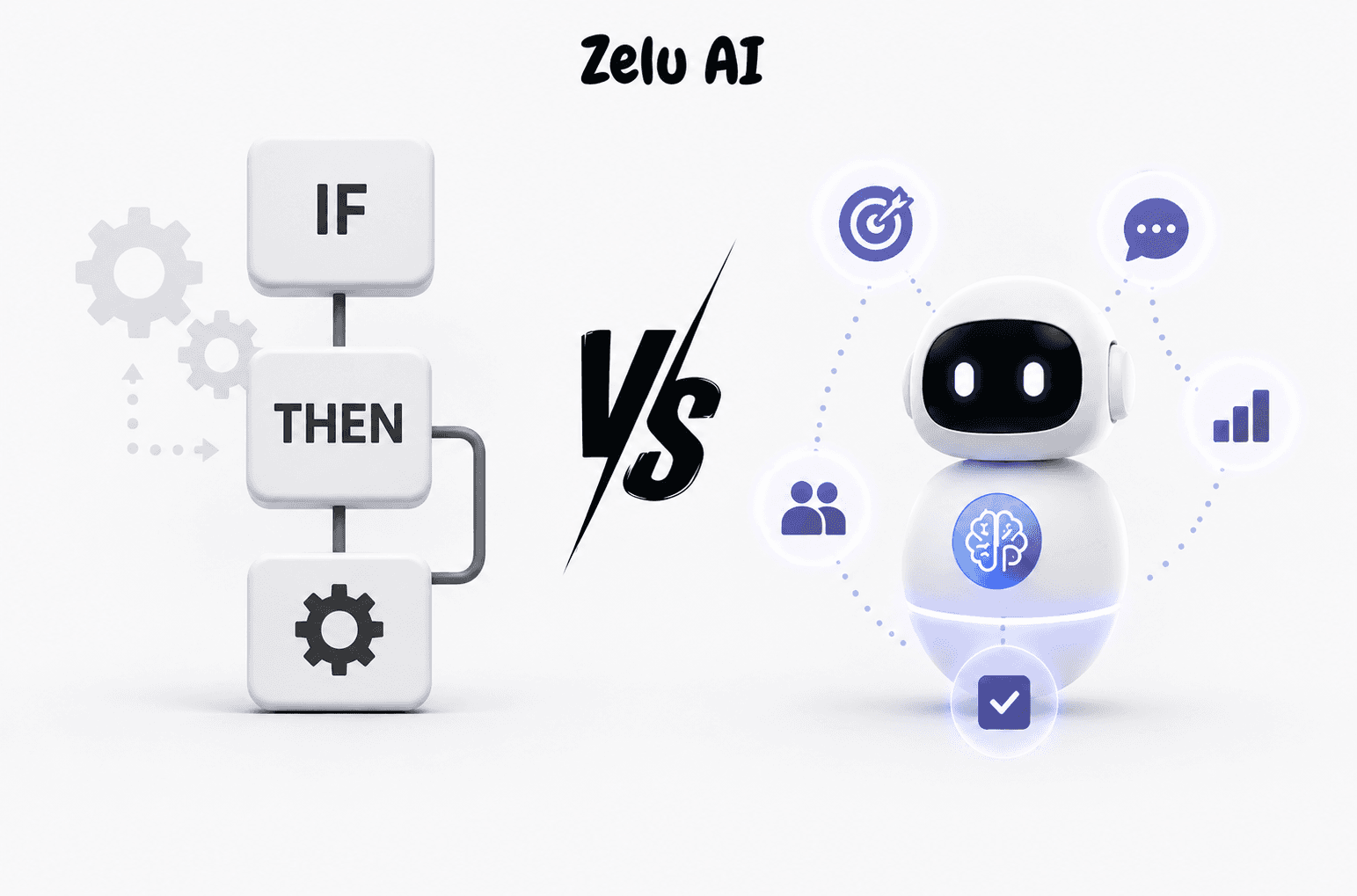
Businesses are no longer just automating repetitive tasks, they are now looking for systems that can think, adapt, and make decisions independently.
This shift has created a growing debate around Rule-Based Automation vs Agentic AI, especially for companies trying to improve workflow efficiency and reduce operational bottlenecks.
While traditional automation relies on fixed rules and structured workflows, agentic AI introduces intelligent automation capable of handling complex business processes dynamically.
Understanding the difference between these two technologies is essential for businesses planning to scale smarter, faster, and with greater operational flexibility.
What is rule-based automation in business systems?
Rule-based automation refers to traditional workflow automation systems that operate on predefined logic such as “if this happens, then do that.” It is widely used in business process automation where tasks need to follow strict, predictable steps without deviation.
At its core, rule-based automation is designed for efficiency in repetitive tasks, not decision-making. It executes instructions exactly as they are written, making it highly reliable and predictable in stable environments but limited when conditions change or require adaptive responses.
What defines rule-based automation systems?
Rule-based systems rely on structured logic and fixed workflows. They are commonly found in business process automation, marketing automation, and CRM systems where consistency matters more than adaptability.
Key characteristics include:
Predefined “if-then” logic structures
Fixed workflows that do not adapt dynamically
Execution based on triggers rather than reasoning
Dependence on manual updates when conditions change
This makes them ideal for predictable environments but less effective in complex, evolving business scenarios.
Where is rule-based automation commonly used?
Rule-based automation is still widely used across industries for task automation and operational efficiency, such as:
Email marketing sequences and drip campaigns
Customer ticket routing in support systems
Invoice processing and data entry workflows
Basic ad campaign rules like budget adjustments
While effective, these systems lack the ability to interpret intent or context beyond their programmed rules.
What is agentic AI and how does it work in real-world systems?
Agentic AI refers to autonomous AI systems powered by natural language processing (NLP) and machine learning that can understand goals, make decisions, and execute multi-step tasks independently. Unlike rule-based automation, it does not rely on static instructions. Instead, it interprets objectives, evaluates context, and dynamically determines how to achieve them.
This shift represents a move toward intelligent automation and AI-driven decision-making systems, where machines behave more like autonomous digital employees rather than simple automation tools. At ZeluAI, we specialize in building agentic AI systems that handle complex, multi-step business processes from content creation to customer support workflows to marketing optimization. These systems learn from outcomes and continuously improve their decision-making.
How does agentic AI operate in business environments?
Agentic AI works through a structured reasoning process rather than fixed rules. It typically follows a cycle of understanding, planning, execution, and refinement.
In simple terms, it:
Receives a goal in natural language
Breaks it into smaller tasks
Selects tools or systems needed to complete each step
Executes actions across platforms
Evaluates outcomes and adjusts behavior
This makes it significantly more flexible than ai automation solutions.
What makes agentic AI different from traditional AI tools?
Unlike basic AI tools that respond to prompts or follow scripts, agentic AI systems are goal-oriented and autonomous. They do not just generate outputs—they actively manage workflows.
Key features include:
Autonomous task execution across systems
Multi-step reasoning and planning
Context awareness and adaptability
Continuous optimization based on feedback
These capabilities make agentic AI highly effective for complex business workflows and dynamic environments such as marketing, operations, and customer experience management.
How do rule-based automation and agentic AI compare in real performance?
To understand which system performs better, it is important to compare them across core business dimensions such as flexibility, intelligence, scalability, and execution capability.
Rule-based automation excels in structured environments, while agentic AI performs better in dynamic and unpredictable scenarios.
Factor | Rule-Based Automation | Agentic AI |
Decision-making | Fixed logic | Context-driven reasoning |
Flexibility | Low | High |
Task complexity | Simple workflows | Multi-step processes |
Adaptability | Manual updates required | Self-adjusting behavior |
Execution style | Trigger-based | Goal-oriented |
Intelligence level | Static | Dynamic |
This comparison highlights a clear pattern: rule-based systems are execution-focused, while agentic AI is outcome-focused.
Why does this difference matter in business workflows?
Modern business systems are no longer limited to repetitive tasks. They involve cross-platform workflows, real-time data interpretation, and decision-heavy operations. In such environments, static automation often becomes restrictive.
Agentic AI, on the other hand, introduces adaptive workflow automation, allowing systems to respond to changing inputs without constant human reprogramming.
Which performs better for business automation and workflow efficiency?
The answer depends on the type of task being performed. Neither system is universally superior; instead, each performs better under specific conditions.
Rule-based automation performs better when the environment is stable and predictable. It is highly efficient for repetitive tasks where logic does not change frequently. However, it struggles when unexpected inputs or variations occur.
Agentic AI performs better when tasks require reasoning, adaptability, and coordination across multiple systems. It is designed for intelligent workflow automation, where outcomes matter more than fixed execution steps.
Where rule-based automation still performs strongly
Rule-based automation remains highly effective in:
Structured data processing workflows
Repetitive administrative operations
Compliance-driven business processes
Simple marketing automation sequences
Its strength lies in speed, consistency, and reliable execution in stable environments where workflows rarely change.
Where agentic AI outperforms traditional automation
Agentic AI excels in:
Customer support resolution systems
Multi-channel marketing optimization
Content creation and SEO workflows
Complex business decision-making processes
It is especially powerful when tasks require dynamic reasoning and cross-platform coordination.
What are the real-world use cases of rule-based automation vs agentic AI?
Both systems are used across modern businesses, but their application differs significantly depending on complexity and adaptability requirements.
How is rule-based automation used in business operations?
Rule-based automation is typically used for structured task automation where decisions are already defined. Examples include:
Automatically sending emails based on user actions
Assigning support tickets based on keywords
Triggering notifications when thresholds are met
Processing standardized financial transactions
These workflows are predictable and do not require interpretation or decision-making.
How is agentic AI used in modern business systems?
Agentic AI is used in more advanced AI workflow automation scenarios where systems must understand intent and execute multiple steps. Examples include:
Managing end-to-end customer support conversations
Running SEO research, content planning, and publishing workflows
Automating lead qualification and follow-ups
Optimizing marketing campaigns across platforms
These systems act more like autonomous digital employees rather than simple automation tools.
What are the limitations of rule-based automation and agentic AI systems?
Both technologies come with limitations that affect how they are deployed in real-world environments.
What are the limitations of rule-based automation?
Rule-based automation is limited by its rigid structure. Once conditions change, the system cannot adapt without manual intervention. This creates operational friction in fast-changing environments.
Its key limitations include:
Lack of adaptability to new scenarios
High maintenance when workflows evolve
No understanding of context or intent
Limited scalability in complex systems
What are the limitations of agentic AI?
While more advanced, agentic AI is not without challenges. Its autonomy introduces complexity in control and predictability.
Common limitations include:
Difficulty ensuring consistent outputs
Higher computational and operational cost
Need for oversight in sensitive operations
Occasional unpredictability in decision-making
This is why many businesses adopt a controlled deployment approach rather than full replacement.
Can rule-based automation and agentic AI work together in hybrid systems?
In many modern architectures, the most effective solution is not choosing one over the other, but combining both into a hybrid automation model.
In this approach, rule-based systems handle structured execution, while agentic AI handles reasoning, planning, and decision-making.
How does a hybrid automation system work?
A hybrid model typically follows a layered workflow:
Agentic AI identifies goals and plans actions
Rule-based systems execute specific tasks reliably
AI systems evaluate outcomes and refine future decisions
This creates a balance between stability and intelligence, ensuring efficiency without losing adaptability.
Final Thoughts
There is no absolute winner between rule-based automation and agentic AI. Each serves a different purpose in the automation ecosystem.
Rule-based automation performs better when tasks are repetitive, structured, and predictable. It delivers speed, consistency, and reliability in controlled environments.
Agentic AI performs better when tasks require reasoning, adaptability, and multi-step decision-making. It enables intelligent workflows that evolve with business needs.
The most effective strategy is not replacement but integration. Businesses that combine both systems create scalable, intelligent, and resilient automation ecosystems capable of handling both simple operations and complex decision-driven workflows.
Frequently Asked Questions
Is agentic AI replacing rule-based automation?
No. Agentic AI is enhancing automation systems rather than replacing them. Rule-based logic still plays a key role in structured workflows.
What is the biggest difference between automation and agentic AI?
Automation follows predefined rules, while agentic AI makes decisions based on goals and context.
Can small businesses use agentic AI systems?
Yes, especially for customer support, marketing, and content workflows where efficiency and scalability are important.
Is rule-based automation still relevant today?
Yes, it remains essential for simple, predictable, and high-speed operational tasks.
Which is more cost-effective for businesses?
Rule-based automation is cheaper to maintain, but agentic AI can deliver higher long-term value in complex workflows.