Insights
/
feb 16, 2025
When to Upgrade an Automation to an Agent?
Not every automation needs to become an agent. See the concrete signals that mean it's time, and the honest signs it's too soon to make the switch.
/
AUTHOR

Gracia Perkin
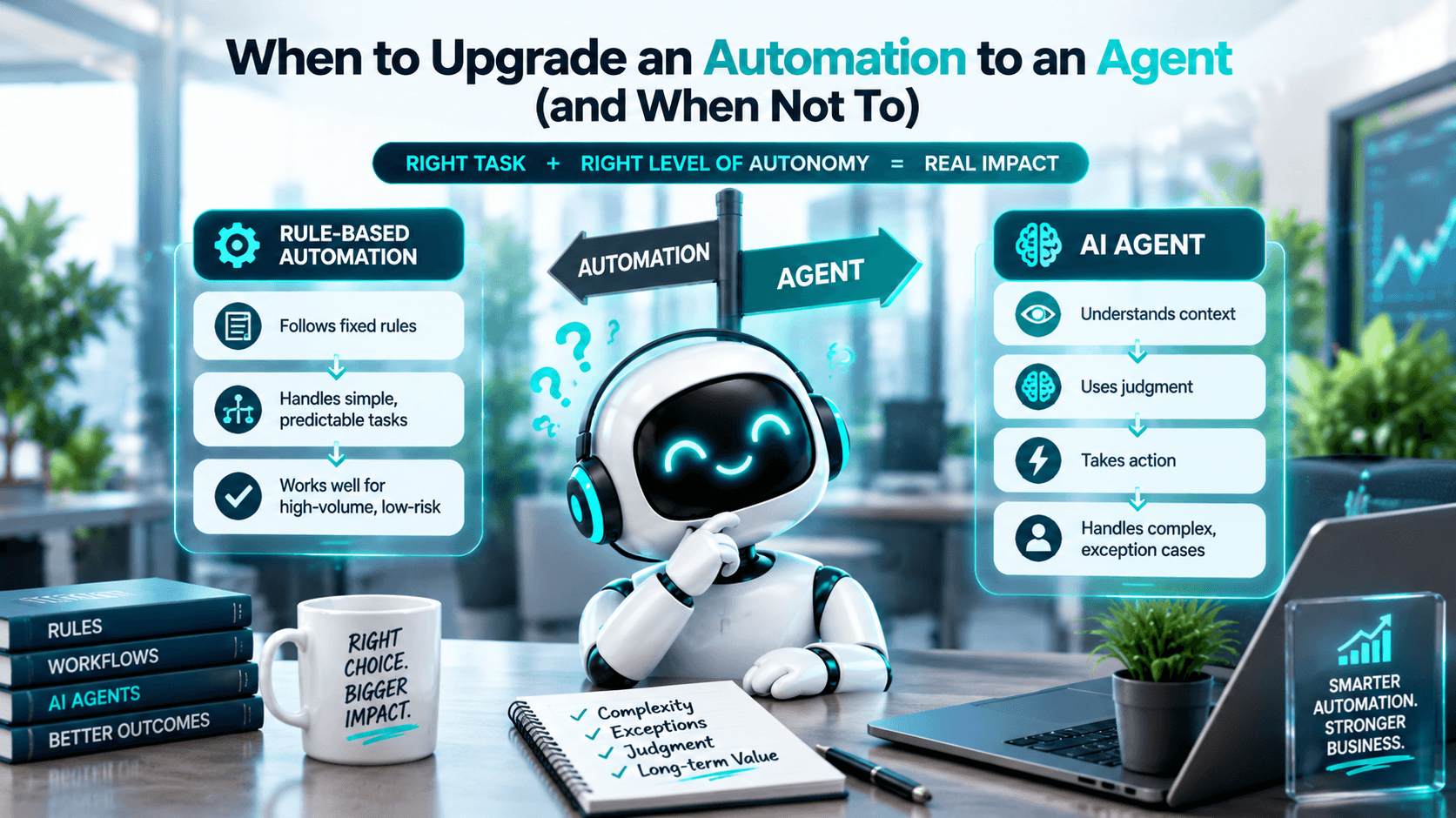
A workflow that used to take three simple rules now takes forty, and someone still has to manually handle the cases those forty rules don't cover. Somewhere in that growth, a genuine question appears: is it time to upgrade this to an agent, or does it just need better rules?
At ZeluAI, we get asked this more than almost anything else, and the honest answer isn't "always upgrade" or "rules are always safer." It's that there's a real signal worth checking for, and just as real a case for not upgrading yet.
Why Is "Can AI Do This" the Wrong Question to Start With?
Almost any task can technically be handed to an agent. That's not the useful question. The question that actually matters is whether it should be, whether the judgment an agent brings is solving a real problem, or just adding complexity to something that was working fine as a simple rule.
An agent isn't a replacement for automation. It's a decision layer that sits on top of it, reserved for the specific place where judgment is genuinely the bottleneck, not applied everywhere out of habit.
What's the Real Difference Between an Automation and an Agent?
A rule-based automation follows fixed logic: if this happens, do that, nothing more. A more advanced workflow automation goes a step further, evaluating a situation and deciding the best response before executing it, still within a defined structure.
An agent goes further still: it observes context, reasons through options, and takes action without being told the exact path to follow at each step. We go deeper into how each of these actually works in rule-based automation vs agentic AI, since understanding that foundation makes the upgrade decision itself much clearer.
Where Does This Distinction Actually Show Up in a Real Workflow?
Picture a support ticket queue. A rule can route "billing" tickets to the billing team. A smarter automation can read a ticket's content and route it based on what it's actually about, not just a selected category.
An agent goes beyond routing entirely, it can read the ticket, pull the customer's account history, resolve the issue directly, and only escalate the cases that genuinely need a person.
What's the Clearest Signal That an Automation Has Outgrown Its Rules?
The clearest sign isn't volume, it's maintenance pain. When a ruleset has grown so tangled that adding one more exception feels risky, when nobody's entirely sure which rule fires first anymore, that's the moment worth paying attention to.
A rule-based system that needs constant patching to handle new edge cases is quietly telling you the logic itself has hit its ceiling, one of the same patterns we've seen show up in why most automation projects fail.
When Does a Task Actually Need Judgment Instead of More Rules?
Judgment becomes necessary when the right answer depends on context a rule can't fully anticipate in advance, weighing multiple pieces of information together, handling a genuine exception, or making a call that a simple category doesn't capture.
Refund approval is a common example: a rule can flag amounts over a threshold, but deciding whether a specific refund is reasonable given someone's account history is a judgment call, not a lookup.
Is This Just a Technical Upgrade, or Something Bigger?
This is worth being honest about. Moving from automation to an agent isn't only a technical change, it's an organizational one.
There's a real gap between a system that only suggests an action for a person to approve, and one that's actually allowed to act on its own, send the email, update the record, issue the refund.
Crossing that gap requires a genuine shift in how much a team is willing to trust the system, not just better technology. A business that hasn't made peace with that shift yet usually isn't ready for an agent yet either, regardless of how capable the underlying model is.
How Do You Decide How Much Autonomy to Actually Give It?
Autonomy should scale with the actual stakes involved, not with how impressive full autonomy sounds. A high-frequency, low-impact task, tagging a lead, drafting a first-pass response, can reasonably run with wide autonomy, since mistakes are simple to catch and fix.
A low-frequency, high-impact decision, a large refund, a account cancellation, warrants a system that recommends an action and waits for a person to confirm it, at least until real-world performance earns more trust over time.
This same principle around limiting what a system is allowed to touch is central to what we cover in AI agent security, where the access an agent has matters as much as how capable it is.
How Should a Business Actually Make This Decision?
The clearest starting point is looking honestly at where the current pain actually sits, a ruleset that's become unmaintainable, exceptions piling up faster than anyone can patch for them, or a task that keeps needing a judgment call no rule can fully anticipate. That's usually where an agent earns its place first, not everywhere at once.
We build custom AI agents designed around exactly this kind of honest assessment, matching the level of autonomy to what a task actually requires rather than defaulting to the most advanced option available. You can see the fuller range of what we build on our services page.
Final Thoughts
Upgrading an automation to an agent isn't a milestone every workflow eventually reaches. It's a specific response to a specific signal, a ruleset that's outgrown its own logic, or a decision that genuinely needs judgment a rule can't capture.
Businesses that get this right aren't the ones that upgrade everything as fast as possible. They're the ones that wait for the real signal, then match the level of autonomy to what the task actually earns, not what sounds most advanced on paper.
Frequently Asked Questions
Can a business upgrade just one part of a workflow to an agent while keeping the rest rule-based?
Yes, this is actually the most common approach, upgrading the specific step that needs judgment while leaving predictable steps running on simple rules.
Does upgrading to an agent mean replacing the existing automation entirely?
No, most agents work alongside existing automation, handling the judgment-heavy parts while rules continue managing the predictable ones.
How do you know if a ruleset has become too complex to maintain versus just needing cleanup?
If cleaning it up would mean rebuilding most of the logic from scratch just to add one new case, that's usually a sign it's outgrown rules entirely, not just messy.
Can an agent be downgraded back to simple automation if it's not working out?
Yes, a well-scoped agent can be narrowed back to a simpler rule-based process if it turns out the judgment layer wasn't actually needed.
Does industry regulation affect how much autonomy an agent can reasonably be given?
Yes, regulated industries often require a human approval step for certain decisions regardless of how capable the underlying system is.


