Insights
/
feb 16, 2025
What LLMs Understand That NLU Cannot Do?
Discover what LLMs understand that traditional NLU cannot: contextual reasoning, sarcasm, conditionals. Learn when approach wins and how to choose.
/
AUTHOR

Gracia Perkin
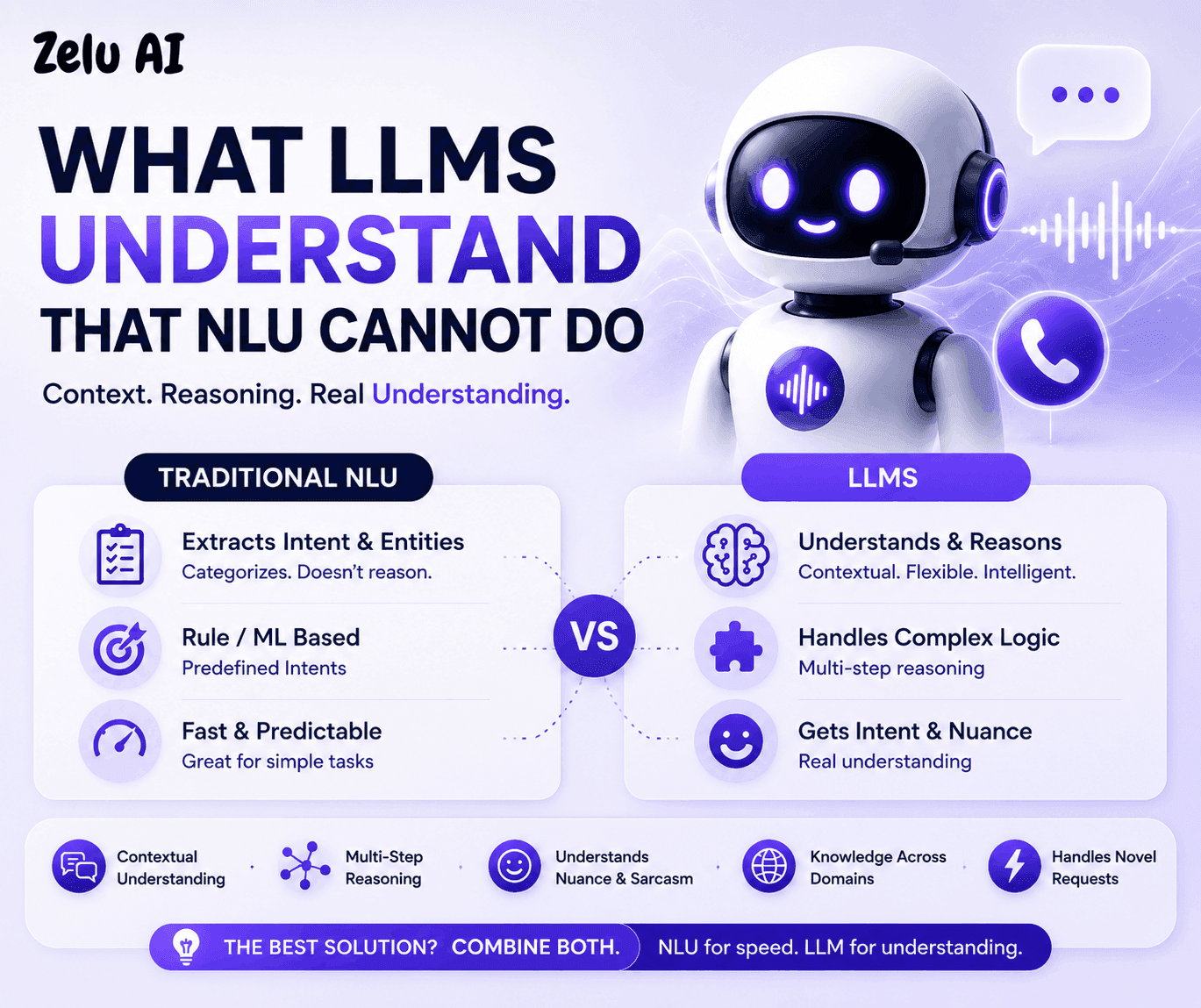
A customer says: "Move my Thursday call to Friday, but only if I don't have conflicts, and cancel the original." Traditional NLU breaks. LLM understands instantly. Here's why the gap exists and what it means for your system.
While LLMs talk, NLUs listen. But recent breakthroughs show LLMs listen better than we thought. The distinction matters. If you're building language understanding systems, understanding this gap will inform every architecture decision you make.
What Does Traditional NLU Actually Do?
Understanding the Foundation
Traditional NLU is designed for one purpose: extract structured meaning (intent and entities) from user input. It categorizes. It doesn't reason.
Rule-based NLU works through keyword matching. User says "call" → triggers intent_schedule_call. Limitations appear immediately: doesn't understand variations, context, or anything unprogrammed. Strength: predictable, explainable, fast.
Machine learning NLU trains classifiers on labeled data. Learns patterns: "schedule", "book", "arrange" → same intent. Handles variations better than rules. Still limits scope to predefined intents. Requires training data. Fails on novel scenarios.
What all traditional NLU shares: narrow scope, entity-focused extraction, confidence threshold-based decisions, no reasoning capability, structured output (intent + entities). NLU excels at categorization. It fails at reasoning.
How Do LLMs Understand Differently?
LLMs don't categorize, they reason. They understand context, implicit meaning, and complex logic without predefined categories.
Contextual understanding separates them immediately. LLMs maintain conversation history across turns. Can resolve referential ambiguity: "Cancel that call" (LLM knows which call, NLU gets confused).
Understand temporal context: "Move my Thursday call to Friday but only if next week" (LLM parses complex temporal logic). NLU has no conversation memory, treats each request isolated.
Real scenario: User books meeting Thursday. Minutes later: "Cancel that and reschedule for Friday instead." NLU doesn't remember Thursday meeting—escalates. LLM recalls context, executes immediately.
Reasoning about conditionals doesn't exist in traditional NLU. User request: "Schedule the call but only if I don't have lunch conflicts." NLU cannot process conditionals—must escalate. LLM reasons through the condition, might fetch calendar data, decides whether scheduling is safe.
Understanding implicit meaning is where LLMs shine. Sarcasm: "Oh, this is just what I wanted" (NLU detects positive sentiment, misses sarcasm). Figurative language: "Can you give me a hand?" (NLU might classify as physical assistance).
LLM understands tone, context, literal versus intended meaning. Academic research confirms: LLMs with proper prompting outperform traditional sarcasm detection by 4-29%.
What Five Capabilities Separate LLMs from NLU?
These aren't small differences. They're architectural. LLMs can do things NLU simply cannot.
Handling Ambiguity and Unclear Requests
NLU approach: Ambiguous request? Confidence threshold fails. Escalate. LLM approach: Considers context and makes probabilistic inference about intent.
Real scenario: "I want to move my thing to next week." NLU: "Thing" is unclear entity, unclear intent → escalate. LLM: Understands from context what "thing" refers to, schedules it. Apple ML research confirms LLMs handle contextual coherence better than traditional systems.
Multi-Step Reasoning and Complex Logic
NLU designed for single-step categorization. LLMs perform chain-of-thought reasoning: break complex requests into steps. Example: "Cancel my 3pm Thursday call, book a new one Friday at 2pm but only if I have less than 8 hours of meetings, and email my colleagues."
NLU: Each step is separate complexity, often fails. LLM: Chains reasoning across all steps, maintains context. This is zero-shot intent orchestration—understanding requests never explicitly trained on.
Sarcasm and Emotional Intelligence
NLU: Sentiment classifier says text is positive → treats as positive. LLM: Understands contradiction between surface sentiment and true intention.
Research shows: LLMs with proper prompting beat traditional sarcasm detection by up to 29%. Example: "Oh sure, waiting 3 hours is exactly what I needed today" (positive words, sarcastic intent). NLU fails. LLM understands.
Knowledge Integration Across Domains
NLU trained on customer support knowledge only → fails on medical terminology. LLMs have parametric knowledge: understand medical, legal, technical, industry-specific language. Retraining required for NLU. LLM adapts immediately.
Cost impact: NLU retraining takes days or weeks. LLM: zero cost. This domain adaptation without retraining is a fundamental advantage.
Handling Linguistic Variation
NLU needs training examples for variations: "book", "schedule", "arrange" all need labeled examples. Requires dozens to hundreds of training examples. LLM: Understands "I'd like to reserve, could you book, please set up" as variations of same intent. Few-shot learning: LLM learns from one or two examples.
What Happens When Traditional NLU Encounters Complex Requests?
Real Failure Modes
Let's look at actual failure scenarios from production systems. Conditionality processing is NLU's biggest blind spot. Production failure from Moveo.AI research: Customer says "My paycheck cleared today, and I wanted to see if I can settle that outstanding balance from last month, but only if there's a discount."
NLU breaks on multiple fronts. Temporal context: "paycheck cleared today" creates time reference. Conditionality: "only if there's a discount" introduces a condition. Discount variable: requires understanding what discount means in context.
Traditional NLU encountered failure mode. LLM: Processes temporal context, understands conditional, might fetch account data, makes decision. Why it breaks: NLU designed for "what is the intent?" not "what are the conditions?"
Referential ambiguity with pronouns happens constantly. Customer in 10-minute conversation:
T=0: "Book me a meeting with John at 2pm Thursday"
T=5min: "Actually, reschedule that to Friday"
T=9min: "And cancel the Thursday one if it hasn't started"
NLU: "That" and "one" are ambiguous without conversation state. LLM: Maintains full conversation context, resolves references instantly.
Request combination breaks categorization-based systems. Customer: "Move the meeting, notify everyone, and adjust the budget." NLU: Designed for single intent, breaks on multiple intents. LLM: Chains multiple reasoning steps, executes coordinated action.
Novel request types aren't in training data. System never saw request type. NLU: No training data = escalate. LLM: Zero-shot reasoning handles novel requests. This is where "in-context learning" enables understanding without retraining.
When Does Traditional NLU Still Win?
Honest Assessment
LLMs aren't universally better. NLU still excels in specific scenarios. Reliability and predictability matter. NLU: Accuracy is consistent, predictable, explainable. LLM: Accuracy varies, sometimes hallucinates, probabilistic output. High-stakes scenarios (compliance, financial): NLU reliability preferred.
Cost at scale changes everything. NLU: Once trained, inference is cheap (milliseconds, pennies per thousand calls). LLM: Each call costs money (API calls) or compute (self-hosted). Scale matters: 1M calls/year changes the calculation. NLU wins on cost.
Explainability and auditability required in regulated environments. NLU: Can show why intent was classified (rule triggered, feature importance). LLM: Black box; can't explain why it decided something. Regulatory environments need explainability.
Speed matters for AI voice agents. NLU: Millisecond responses. LLM: Hundreds of milliseconds (LLM latency for reasoning). Voice agents require <500ms total latency. NLU advantage here.
Where NLU still wins: simple, repetitive intents (booking, FAQs, password reset), structured data extraction (forms), high-volume cost-sensitive scenarios, compliance-critical applications.
Should You Choose LLM, NLU, or Both?
The Hybrid Approach
Smart companies aren't choosing. They're combining. Hybrid architecture pattern: NLU for intent classification + entity extraction (fast, reliable, structured). LLM for reasoning and complex requests (flexible, capable).
Route simple intents to NLU (fast, cheap). Route complex requests to LLM (capable, expensive). Result: cost-effective plus capable.
Modern conversational AI platforms like Zelu AI use this hybrid architecture to balance speed, reliability, and advanced reasoning in production voice and chat systems.
NLU as filter, LLM as reasoning engine works well. NLU extracts intent + entities (structured input for LLM). LLM uses structured input to reason.
Reduces LLM token usage (more efficient). Example: NLU extracts "intent: reschedule, meeting: John call, new_time: Friday 2pm." LLM receives structured input, reasons about conditionals plus feasibility.
Real-world hybrid implementation: Customer support simple FAQs → NLU; complex issues → LLM. Voice agents: High-volume standard queries → NLU; edge cases → LLM. Financial services: Routine transactions → NLU; complex products → LLM.
Cost-benefit is clear: 70% of requests are simple (NLU handles: fast, cheap). 30% are complex (LLM handles: capable, worth cost).
Final Thoughts
Understanding when each approach wins matters more than picking one. What LLMs understand better: complex reasoning (if-then logic), contextual understanding (conversation memory), implicit meaning (sarcasm, figurative language), novel requests (zero-shot generalization), domain flexibility (knowledge integration).
What NLU does better: reliability (predictable, explainable), speed (millisecond latency), cost (at scale), auditability (compliance).
The real opportunity: combining both. NLU for what it does best (fast, structured extraction). LLM for what it does best (complex reasoning, context). Hybrid systems are becoming standard, not exception.
FAQs
Can we add LLM understanding to existing NLU systems without replacing them?
Yes, deploy LLMs alongside NLU as a decision router—simple queries → NLU (fast, cheap), complex queries → LLM (capable, expensive). This hybrid approach maintains existing investments while gaining new capabilities.
How long does it take to retrain NLU vs. adapt LLM to new domains?
NLU retraining requires labeled data collection, model training, and testing—typically 2-4 weeks for new domain. LLM adaptation through prompting or few-shot learning: hours to days. Domain knowledge is embedded in LLM weights, requiring no retraining.
Do LLMs hallucinate during routine queries like scheduling or form filling?
Hallucination risk increases with open-ended reasoning but decreases in structured tasks (scheduling, form filling, simple bookings). NLU + LLM hybrid minimizes hallucination: NLU routes simple tasks (zero hallucination risk), LLM handles complex reasoning where accuracy can be validated.


