Insights
/
feb 16, 2025
Generative AI Consulting Services: Idea to System
Turn your business idea into a custom AI system. Learn how generative AI consulting services guide planning, testing, CRM integration and launch.
/
AUTHOR

Gracia Perkin
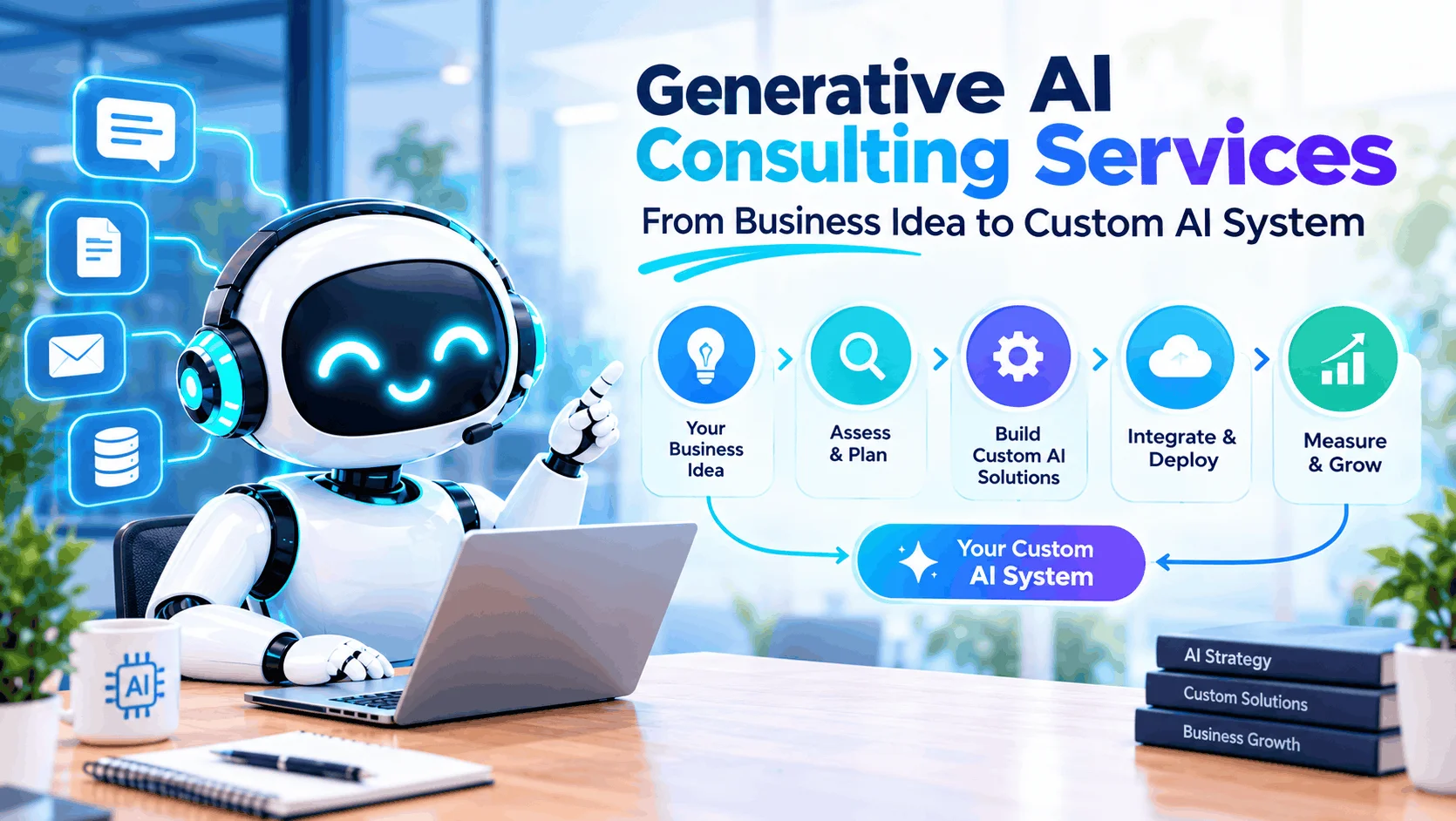
Your staff read enquiries, search company documents, write replies, and update customer records. You can see where time disappears, but deciding what AI should handle is less obvious.
Generative AI consulting services help turn that uncertainty into a defined project. The work starts with your business problem, available data, and expected outcome before moving into technical decisions.
At zeluai, we build custom AI agents, CRMs, and software around business workflows. A useful starting point is choosing one process that can be improved, tested, and connected to the systems you already use.
What Are Generative AI Consulting Services?
Generative AI consulting services help businesses identify suitable use cases, assess readiness, select a technical approach, and plan implementation. The output should explain what to build, why it is worthwhile, and how success will be measured.
The engagement may include an AI readiness assessment, architecture recommendations, a proof of concept, or an implementation roadmap. Development and ongoing support must be agreed separately unless they are explicitly included.
Consulting creates direction. Engineering turns that direction into working software. Understanding how AI consulting differs from an automation agency helps clarify what your chosen partner will actually deliver.
How Do You Know Whether Your Idea Needs Generative AI?
Generative AI is worth evaluating when a workflow involves varied language, documents, or responses that fixed rules struggle to handle. It is not necessary for every repetitive task.
Which Workflows Make Useful Starting Points?
Suitable examples include answering questions from company documents, summarising conversations, extracting enquiry details, and drafting personalised follow-ups.
Consider a service business receiving enquiries by email. An assistant could identify the requested service, retrieve approved information, draft a response, and prepare a CRM update for review.
When Is Simpler Automation Enough?
Copying a form submission into a CRM or sending a fixed reminder may only require ordinary automation.
A feasibility assessment should make that distinction early. Choosing the simpler approach can reduce development cost and maintenance without sacrificing the desired outcome.
What Should You Receive Before Custom Development Begins?
Before development, you should receive a defined use case, an assessment of required data and integrations, and a scoped delivery plan. These documents turn a broad idea into something your business can evaluate.
A Clear Workflow and Success Criteria
Specify who uses the system, what information enters it, and what result it should produce. Identify actions it may take and decisions requiring approval.
For the enquiry assistant, success might mean shorter handling time while keeping responses accurate. Measure the current process first so later improvements have a meaningful baseline.
A Data Assessment and Delivery Roadmap
Your partner should identify source documents, CRM fields, available APIs, and missing information.
The roadmap should then explain milestones, responsibilities, dependencies, estimated costs, and acceptance criteria. It should also state what falls outside the initial scope.
How Does Your Company Data Shape the AI System?
Company data determines what the system can reliably retrieve and explain. A model’s general knowledge cannot replace your current service information, customer records, or internal policies.
When Do You Need a Connected Knowledge Base?
A knowledge assistant may use retrieval-augmented generation, or RAG, to find relevant company information before preparing an answer.
IBM’s explanation of retrieval-augmented generation describes how this connects a model with external knowledge sources. For a business, those sources could include approved documents and service information.
Retrieval still needs testing. Outdated documents, conflicting policies, and incorrect access permissions can produce unreliable results.
Do You Need to Train a New Model?
Not necessarily. A custom AI solution can combine an existing language model with company knowledge, integrations, and business logic.
Fine-tuning may help particular tasks, but it should follow a demonstrated need. Model selection should consider response quality, cost, speed, and data-handling requirements.
How Does a Proof of Concept Become a Custom AI System?
A proof of concept tests whether the proposed approach works. Production development adds the reliability, integration, and support needed for everyday use.
Test Representative Business Requests
Evaluate genuine examples, including incomplete enquiries, unfamiliar questions, and conflicting information.
For the enquiry assistant, check whether it selects the correct service information and avoids unsupported promises. A convincing demonstration is insufficient if difficult cases require constant correction.
Connect Approved Actions to Your Software
When the workflow needs to retrieve information and perform actions, custom AI agent development becomes relevant. The system needs defined permissions and rules governing what it can change.
CRM integration should account for required fields, duplicate contacts, and failed updates. The agent should not report that a record was saved unless the operation succeeded.
Prepare for Daily Use
Before launch, define error handling, human review, monitoring, and support responsibilities. Staff also need training and documentation. Someone must own source-information updates and review performance when business processes change.
What Affects the Cost and Timeline?
Cost and timeline depend on the workflow, data quality, integrations, deployment requirements, and evaluation needed. A focused assistant over organised documents differs substantially from an AI-enabled CRM with several connected processes.
Separate advisory work, prototype development, production engineering, and operating expenses when comparing proposals.
Ongoing costs may include model usage, hosting, monitoring, and maintenance. Ask how these costs could change as usage grows.
A staged engagement lets you assess evidence before approving a larger build. It also makes it easier to adjust scope when the initial idea proves more complex than expected.
How Should You Choose a Generative AI Consulting Partner?
Choose a partner who can explain the proposed deliverables, demonstrate relevant implementation experience, and define responsibility after launch. Technical capability matters alongside understanding your business process.
Ask how they test accuracy, handle unsuccessful actions, and connect AI with existing software. A useful proposal should describe more than the model it intends to use.
Clarify source-code ownership, documentation, third-party licences, hosting accounts, and maintenance arrangements. Discuss applicable privacy requirements during scoping rather than assuming a custom build automatically satisfies them.
Our AI consulting connects planning with custom development. Start with a specific workflow, its current limitations, and the improvement you want to measure. That gives the project a practical foundation.
What Else Should You Know Before Starting?
Before committing, clarify the engagement’s scope, integration requirements, and ownership. These common questions help resolve those decisions.
Does Generative AI Consulting Include Software Development?
Not always. Confirm whether the agreement covers advice, a prototype, production development, deployment, and ongoing support.
Can Generative AI Work With Our Existing CRM?
Often, yes, where suitable APIs and permissions are available. Feasibility depends on the CRM, required actions, and accessible data.
Do We Need Our Own Data Science Team?
Not necessarily. A development partner can provide specialist expertise, but your business still needs someone to define requirements and review outcomes.
Can a Small Business Benefit From Generative AI Consulting?
Yes, when a defined workflow offers enough expected value to justify the investment. Start with a focused assessment rather than a broad transformation.
Who Owns the Custom AI System?
Ownership depends on the contract. Agree on source code, documentation, business data, hosting accounts, and third-party dependencies before development begins.


