AI Strategy
/
feb 16, 2025
From Curiosity to Conversion: How 100+ Companies Integrated AI Chatbots and What You Can Learn From Them
Still routing every inquiry to human agents? ZeluAI has deployed AI chatbots for 100+ companies — cutting support costs by 40%. See the results and get started.
/
AUTHOR

Gracia Perkin
The Problem With Most Business Chatbots (And Why Companies Keep Getting It Wrong)
You've probably interacted with a bad chatbot. The kind that loops you in circles, doesn't understand what you're asking, and ends every conversation with "Sorry, I don't understand. Please contact support." That experience has poisoned the well.
A lot of business owners hear "AI chatbot" and picture exactly that, a glorified FAQ widget that creates more frustration than it solves. The reality in 2026 looks completely different. Modern AI chatbots built on large language models (LLMs) and fine-tuned on your specific business data can resolve complex customer queries, handle multi-turn conversations, integrate with your CRM and ticketing system in real time, and hand off to human agents seamlessly when needed, all in multiple languages, around the clock. The difference between a bad chatbot and a great one isn't the technology. It's the implementation.
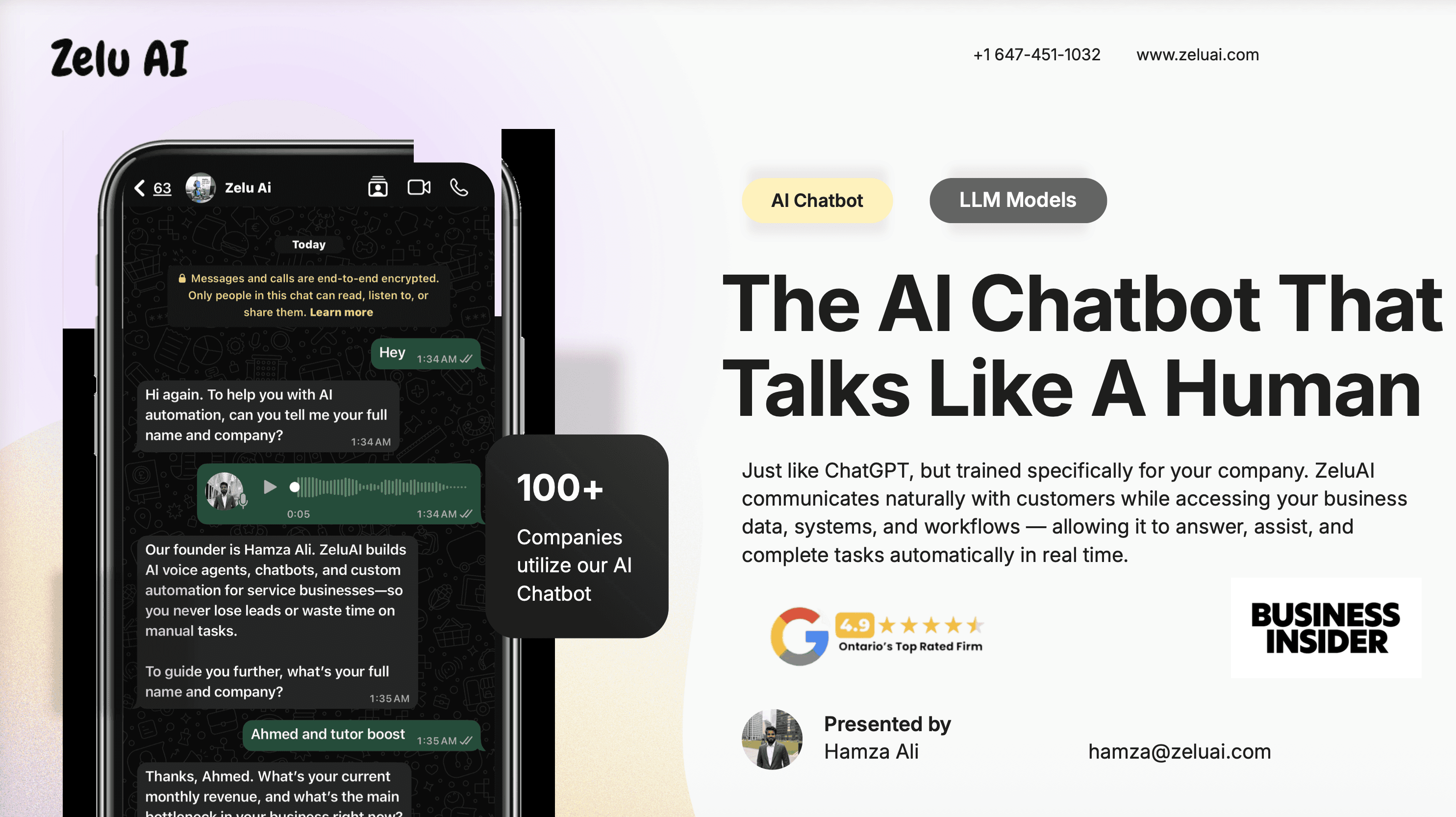
Over the past three years, ZeluAI has built and deployed AI chatbots for more than 100 companies across the UAE, Canada, Saudi Arabia, Kuwait, and beyond across industries ranging from commercial real estate and automotive to healthcare administration and enterprise SaaS. This post breaks down what we've learned, what actually works, and how to think about AI chatbot adoption at every stage of your business journey.
What Is an AI Chatbot, Really?
An AI chatbot is software that uses Natural Language Processing (NLP) to understand human language not just keywords and generate responses that feel natural, contextual, and accurate. Unlike rule-based bots from the early 2010s, modern AI chatbots understand intent. If a customer types "I wanna check on my thing from last week," a well-built AI chatbot understands that "thing" likely refers to an order, delivery, or ticket and pulls the relevant record from your backend without asking the customer to rephrase. This shift from keyword matching to intent understanding is what makes AI chatbots genuinely useful in 2026.
How Do AI Chatbots Work?
The mechanics, simplified into four steps:
Step 1 — Input analysis. The customer sends a message. The AI reads it and identifies the intent (what they want), entities (specific details like order numbers or dates), and sentiment (are they calm, frustrated, urgent?).
Step 2 — Context retrieval. The chatbot checks connected systems your CRM, database, knowledge base, or ticketing platform — to pull information relevant to that specific customer and their specific query.
Step 3 — Response generation. Using the retrieved data and the conversation history, the AI generates an accurate, personalized response not a generic template.
Step 4 — Escalation or resolution. The AI either resolves the query fully or, if the situation requires human judgment, escalates to a live agent with the entire conversation context already attached.
This cycle runs in under a second and can handle thousands of conversations simultaneously.
Why Are Businesses Adopting AI Chatbots So Fast?
The numbers explain it better than any argument. Nearly 35% of Gen Z in the U.S. already use AI chatbots to search for information, and that behavior is extending into how they expect to interact with businesses. ChatGPT alone processes 2.5 billion prompts per day - a signal of how normalized conversational AI interaction has become for consumers everywhere.
For businesses, the driver is simpler: AI chatbots resolve 50–70% of inbound support inquiries automatically, without any human involvement. That's 50–70% of your support cost that can be redirected toward growth.
The Questions We Get Asked Most Before Clients Sign
"How long until we see ROI?" Most clients see positive ROI within 45–60 days of full deployment. The math is straightforward: if your team handles 500 tickets per week at an average cost of $8–12 per ticket, and the chatbot resolves 55% of those automatically, you're saving $2,200–$3,300 per week from month two onward.
"What if customers don't want to talk to a bot?" This comes up constantly and the data consistently contradicts the fear. When a chatbot is fast, accurate, and resolves the problem customers don't care whether it's AI or human. What they care about is resolution speed and accuracy. A slow, inaccurate human agent scores lower on CSAT than a fast, accurate AI chatbot. The experience matters more than the label.
"Can it handle Arabic properly?" Yes and this is one of ZeluAI's core differentiations. Our Arabic NLP implementation handles Modern Standard Arabic, Gulf dialect, Levantine dialect, and Egyptian dialect with high accuracy. We don't use translation layers. We deploy natively trained models and test extensively against real-world Arabic customer conversations before any deployment goes live.
"What happens when the AI gets it wrong?" We design every deployment with the assumption that the AI will occasionally fail. The escalation logic is not a fallback it's a primary design component. Every client gets a defined escalation matrix that specifies exactly which conditions trigger human handoff, what context transfers automatically, and how agents are notified. When the AI gets it wrong and escalates properly, customers' satisfaction is barely impacted. When it gets it wrong and doesn't escalate — that's what damages relationships, and our QA process is designed to eliminate those scenarios before launch.
How to Get Started With ZeluAI
If you've read this far, you already know that AI chatbots work. The question is whether yours will be one of the ones that drives real business results or one of the ones gathering dust in your tech stack.
The difference is in how you implement it. ZeluAI has built and integrated AI chatbots for more than 100 companies. We know what the most common failure points are, we've built processes to avoid them, and we work on fixed-scope, outcome-focused engagements meaning you know exactly what you're getting before any work begins.
The starting point is a free strategy call. We'll review your current support workflows, identify your highest-ROI chatbot use cases, and give you an honest assessment of what a deployment would look like for your specific business timeline, cost, and projected results.
👉 See ZeluAI's AI Chatbot services and request your free strategy call here.
No generic sales pitch. No obligation. Just a direct conversation about whether AI chatbot automation makes sense for your business right now.
Frequently Asked Questions
What industries does ZeluAI build AI chatbots for? ZeluAI has deployed AI chatbots across commercial real estate, automotive, healthcare, news and media, enterprise SaaS, e-commerce, and field service management. Our solutions are custom-built for each client's specific workflows and industry requirements.
How long does it take to deploy an AI chatbot with ZeluAI? Most standard deployments take 2–5 weeks from discovery to live deployment. Complex enterprise integrations with multiple system connections may extend to 6–8 weeks.
Does ZeluAI support Arabic language AI chatbots? Yes. Arabic NLP is a core specialization for ZeluAI. We build natively Arabic AI chatbots — not translation layers — and support multiple Arabic dialects including Gulf, Levantine, and Modern Standard Arabic.
What platforms can ZeluAI's AI chatbots deploy on? Website (embedded chat widget), WhatsApp Business API, mobile apps (iOS and Android), Microsoft Teams, and custom API integrations with your existing systems.
How much does an AI chatbot from ZeluAI cost? Pricing depends on complexity, integration requirements, and deployment scope. Request a free consultation and we'll provide a specific, transparent proposal for your use case.
ZeluAI is an AI automation agency with offices in the UAE and Canada, specializing in custom AI chatbot development, AI voice agents, and end-to-end automation solutions for mid-market and enterprise clients.