رؤى
/
16 فبراير 2025
Why Businesses Are Replacing IVR With AI Voice Agents
IVR routes calls, but doesn't resolve them. See why businesses are switching to AI voice agents and why many still hesitate to make the change.
/
مؤلف

غرايسيا بيركين
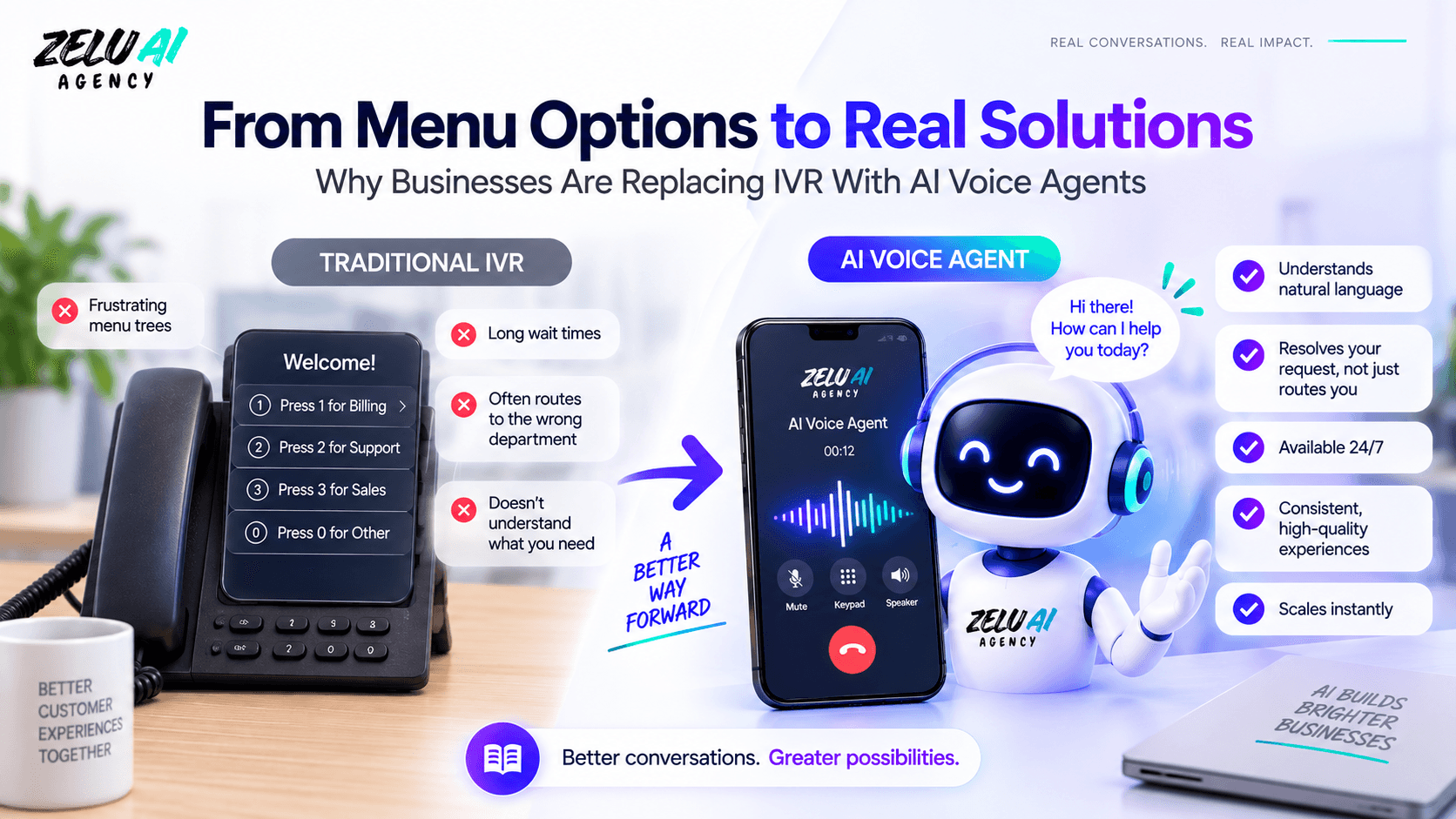
Press 1 for billing. Press 2 for support. Press 3 if neither one fits, which somehow it never does. Millions of people go through this exact routine every day, and most of them have learned to expect it, not to enjoy it, sighing before the first prompt even finishes playing.
At ZeluAI, we've watched this shift happen from both sides, businesses that know their phone system frustrates people, and businesses genuinely unsure whether replacing it is worth the disruption. Both reactions make sense, and understanding why helps explain what's actually changing right now.
Why Are So Many Businesses Moving Away From IVR?
For decades, interactive voice response was the standard trade-off: route callers through a menu tree, keep staffing needs manageable, accept that some percentage of people would get frustrated along the way. It wasn't a great experience, but it was the only practical option available for handling call volume at scale.
That trade-off isn't the only option anymore. AI voice agents now handle the same volume while actually resolving what a caller needs, not just pointing them toward a department that might.
What Exactly Is Wrong With How IVR Works?
IVR runs on fixed menus and rule-based logic, if the caller presses this, route them there. It doesn't understand what someone is asking, it only recognizes which button they pressed or which limited phrase they said. Every possible reason someone might call has to be anticipated in advance and built into the menu tree.
Why Does a Simple Request Sometimes Not Fit Any Menu Option?
Real requests rarely sort cleanly into three or four categories. A caller with a billing question that's actually about a technical issue has no good option, every choice feels wrong, and pressing the closest one often means getting routed to the wrong department entirely, then transferred, then asked to repeat everything they already said.
How Have Customer Expectations Actually Changed?
People now talk to conversational AI constantly, through their phones, their cars, their smart speakers, without a second thought. That experience resets what feels normal. A robotic menu that hasn't changed since it was built years ago feels like a step backward the moment the call connects.
How Does an AI Voice Agent Actually Resolve Calls Instead of Just Routing Them?
An AI voice agent uses natural language understanding to interpret what a caller actually means, not just which keyword matched. A decision layer determines the right response or action, and an action layer executes it directly, pulling account details, updating a record, or completing a task, rather than simply forwarding the caller to someone else who has to start over.
What Happens When a Caller's Request Doesn't Fit a Predictable Pattern?
This is where the difference becomes obvious. A menu tree has no fallback beyond its predefined options. A well-built voice agent can ask a clarifying question, adjust based on the answer, and still move the conversation forward, the same way a person would, rather than forcing the caller back to a list of choices that don't apply.
If IVR Is So Frustrating, Why Haven't More Businesses Already Switched?
This is worth being honest about, because the hesitation isn't unreasonable. Most legacy IVR systems are tangled into routing logic, compliance workflows, and reporting tools built up over years, sometimes by people who no longer work at the company.
In some organizations, the person who originally understood how the whole system fits together left the company long ago, leaving everyone else afraid to touch it.
There's also a real reluctance to walk away from a platform a business has already invested heavily in building out. A business understandably hesitates to tear out something it's spent years shaping, especially when it still technically works, even if it works poorly. None of this means the hesitation is wrong. It means the switch has to be handled carefully, not that it shouldn't happen at all.
How Do Businesses Actually Make the Switch Without Breaking What Already Works?
The safest approach isn't ripping out the existing system in one move. It's layering a voice agent on top of specific call types first, an after-hours queue, one high-volume FAQ, one narrow use case, while the rest of the system keeps running exactly as it does today.
Some businesses go a step further and pilot the new system silently before it ever answers a real call, letting it listen in and suggest responses to a human agent first, so any gaps in its understanding surface before a customer ever notices them. This mirrors the same rule-based-versus-adaptive distinction we cover in rule-based automation vs agentic AI, since IVR is itself a rule-based system being replaced by something that reasons instead of just branching.
Does This Mean IVR Disappears Completely?
Not necessarily, and not immediately. For a genuinely simple, low-stakes routing task, checking a store's hours, confirming an address, a basic menu can still do the job adequately. The bigger shift is that fewer and fewer calls actually stay that simple once a caller starts talking, which is exactly where IVR runs out of road.
How Should a Business Get Started?
The clearest starting point is looking at which calls currently create the most friction, the ones that get misrouted, the ones callers abandon partway through, the ones handled the same way regardless of language or dialect.
That last point matters more than businesses often expect, a detail we cover further in multi-language AI voice agents, since a rigid menu system tends to serve non-standard dialects even worse than it serves everyone else.
At ZeluAI, we build AI voice agents around exactly this kind of careful, layered migration, replacing what's actually causing friction first rather than the whole system at once. You can see the fuller range of what we build on our services page.
Final Thoughts
IVR wasn't a bad idea when it was built. It solved a real problem with the tools available at the time. What's changed is that a better tool now exists, one that understands what a caller is actually asking rather than which button they happened to press.
Businesses that succeed with this transition tend to be the ones that respect why the hesitation existed in the first place, then replace the most painful parts first instead of everything at once. That approach protects what already works while finally fixing what hasn't worked for a long time.
Frequently Asked Questions
Can an AI voice agent work alongside an existing IVR system, or does it have to fully replace it?
It can work alongside it, many businesses start by layering a voice agent onto specific call types while the rest of the IVR stays in place.
Does switching away from IVR mean losing call recording and compliance features already in place?
No, a well-planned migration keeps existing compliance and recording requirements intact, since these live alongside the conversation layer, not inside it.
How long does a typical phased migration from IVR to AI voice agents take?
It varies by scope, but starting with a single call type or time window is usually manageable within a matter of weeks rather than months.
Do customers need to be told they're talking to an AI voice agent instead of IVR?
This depends on local regulations and company policy, though many businesses disclose it briefly at the start of a call regardless.
Can an AI voice agent handle the same call volume an IVR system currently manages?
Yes, voice agents are generally built to handle multiple simultaneous calls without the volume limitations a staffed system would face.


