رؤى
/
16 فبراير 2025
What Does RAG Mean in AI? Understanding the Relation
Learn what RAG means in AI. Understand RAG, how it works, when to use it, and why it's becoming the standard for production AI systems.
/
مؤلف

غرايسيا بيركين
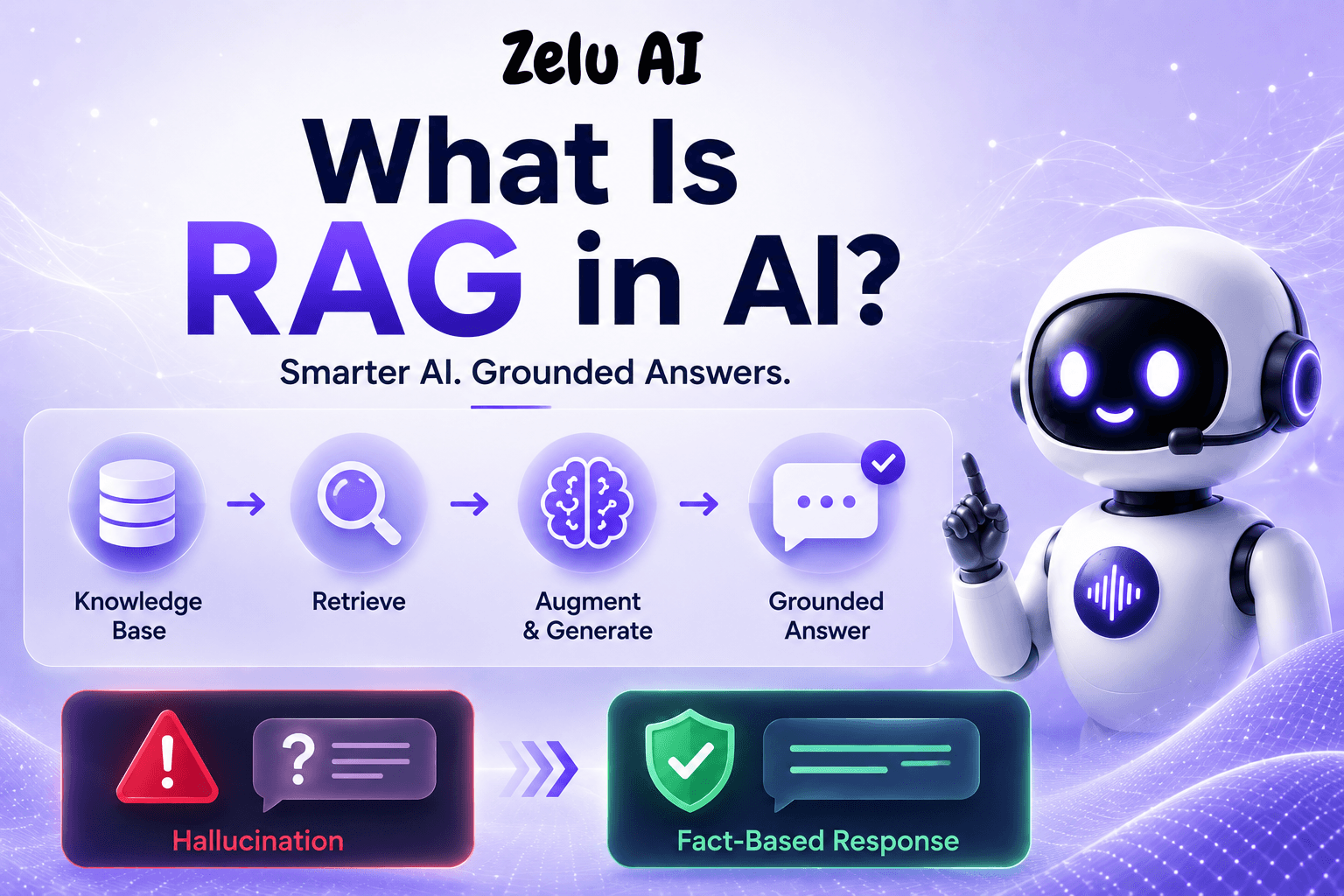
Your AI chatbot confidently tells a customer their warranty covers water damage. It doesn't. The LLM hallucinated. This is the core problem RAG retrieval-augmented generation solves.
Instead of AI systems guessing from training data, RAG grounds responses in actual facts from external knowledge bases.
Understanding what RAG means, how it works, and when to use it is essential for anyone evaluating AI systems or trying to understand how production AI actually delivers reliable answers.
What Exactly Is RAG? Defining Retrieval-Augmented Generation
Understanding the Problem RAG Solves
Large language models are incredibly powerful but fundamentally limited. They guess. They hallucinate facts, outdated information, things that don't exist. An LLM trained in January 2025 doesn't know about your company's policies, your product specs, or your customer data. It can't access real-time information.
RAG fixes this by grounding AI responses in facts from external knowledge bases instead of relying solely on training data.
Breaking Down the Acronym
RAG stands for three interconnected steps. Retrieval means finding relevant information from external sources (your documents, databases, knowledge bases). Augmentation means enhancing the AI model's prompt with that retrieved information. Generation means creating the response based on both original knowledge plus retrieved facts.
Combined: Find facts → Enhance the prompt → Generate grounded response.
Why This Matters Right Now
Forty percent of poorly evaluated RAG systems still hallucinate despite accessing correct information. This is the Stanford benchmark. Most teams don't evaluate their RAG properly, which means their AI systems fail in production. When accuracy matters—customer support, medical advice, legal documents, financial guidance—hallucinations cost money and damage trust.
How Does RAG Actually Work? The Complete Technical Pipeline
RAG works through a systematic pipeline that starts once and then repeats as needed. First, you prepare your knowledge base by breaking it into manageable chunks. A product manual becomes features, troubleshooting guides, specifications. These chunks are typically 512-2048 tokens each.
Second, you convert chunks into vector embeddings—numerical representations that capture semantic meaning. These embeddings get stored in a vector database (Pinecone, Weaviate, Milvus). This enables fast semantic similarity search, not just keyword matching.
Third, when a user asks a question, the system converts that question into a vector and searches the vector database for similar chunks. It retrieves the top 3-5 most relevant results in milliseconds.
Fourth, the system augments the original question with retrieved documents and sends this enriched prompt to the LLM. The LLM generates a response grounded in actual facts, not guesses.
Why This Architecture Works
The LLM still does what it does best: understand language, reason about complex questions, synthesize information. But now it has access to the facts it needs. Hallucinations drop dramatically because the model responds to actual context.
Knowledge base updates instantly. No retraining required. When your company policy changes, you update the document. The RAG system immediately uses the new information. This flexibility is why RAG beats fine-tuning for most use cases.
How Does RAG Compare to Fine-Tuning and Other Approaches?
RAG vs Fine-Tuning: Which Should You Choose?
Fine-tuning retrains a model on new data. RAG retrieves information from external sources. The differences matter significantly. Fine-tuning costs ten to fifty thousand dollars or more, with deployment taking two to four weeks. RAG costs two to five thousand dollars and deploys in one to two weeks.
When your data changes, fine-tuning forces expensive retraining. RAG requires simply updating documents. If you need to retrain monthly because your company updates policies regularly, fine-tuning becomes financially unsustainable. RAG scales linearly with document updates.
Fine-tuning works well for customizing writing style and brand voice. Use it when you want the model to sound like your company. RAG excels at accuracy and grounding responses in facts. Use it when you need correct answers.
Most production systems use both. Fine-tune for style, use RAG for accuracy.
RAG vs Simple Vector Search
Vector search retrieves documents. RAG retrieves plus generates. Use vector search when you want users to find articles. Use RAG when you want conversational answers to complex questions. RAG adds reasoning on top of retrieval.
RAG vs Prompt Engineering
Writing clever prompts guides model behavior. RAG systematically retrieves context. Prompting works for general knowledge and creative tasks. RAG works for accuracy where large knowledge bases matter. The best systems combine both approaches.
What Really Goes Wrong When Implementing RAG?
The Evaluation Problem Competitors Ignore
Most RAG failures happen in retrieval, not generation. Your system retrieves wrong documents, generates good answers to wrong information. Yet most teams test prompts when the problem is bad retrieval. They skip systematic evaluation entirely.
RAG evaluation has two separate failure classes. Retrieval errors happen when the system retrieves irrelevant documents. Generation errors happen when the LLM agents overlooks retrieved context and hallucinates. These need different fixes.
Common evaluation mistakes destroy production RAG systems. Testing only simple queries? Real queries are complex. Accuracy drops twenty-five to thirty percent on realistic distributions versus demo data. Not testing edge cases? Ambiguous queries, contradictory information, questions outside your knowledge base will break your system.
Many teams assume retrieved context automatically guarantees truth. It doesn't. If your source document is outdated or poorly written, RAG outputs garbage. Clean knowledge bases matter more than sophisticated models.
Chunking and Retrieval Failures
Chunks too small lose context. Chunks too large add noise. Most teams spend days experimenting with chunk sizes (typically 512 to 2048 tokens) without systematic testing. Semantic chunking, breaking documents at logical boundaries rather than token counts—improves retrieval significantly.
Retrieval failures happen when wrong documents get retrieved. Solutions include hybrid search (combining keyword and semantic search), re-ranking to score results by relevance, and query rewriting to rephrase unclear questions better.
When Should You Use RAG? Decision Framework?
Ask These Critical Questions
Do you need current or proprietary data?
If yes, RAG is right. General knowledge questions work fine with LLMs alone.
Will your data change frequently?
If yes, RAG enables instant updates. Fine-tuning becomes expensive if you retrain monthly.
Is accuracy critical?
If yes, RAG grounds responses in sources. Medical advice, legal documents, financial guidance need RAG.
Do you have a large knowledge base?
If yes, RAG scales to millions of documents. Small datasets don't justify RAG complexity.
Do you need to cite sources?
If yes, RAG provides attribution. Conversational AI benefits from source visibility.
When RAG Wins?
Use RAG for customer support chatbots that answer from your help documentation.Voice agents that book appointments by accessing real availability. Use RAG for internal knowledge search where employees ask about company policies. Use RAG for legal or medical applications where accuracy and source attribution are mandatory.
When Other Approaches Win?
Use fine-tuning when you want specific writing style and brand voice. Use prompt engineering for creative tasks, reasoning problems, general knowledge questions. Use simple LLMs without augmentation for casual conversations where accuracy doesn't matter.
The Business Case for RAG
Real Impact in Production
A SaaS company implemented RAG-powered customer support. They had ten thousand monthly support tickets. Before RAG, seventy percent escalated to humans at fifty dollars per ticket.
After RAG, forty percent escalate. Support costs dropped from three hundred fifty thousand dollars monthly to eighty thousand dollars monthly. RAG implementation cost five thousand dollars per month.
That's two hundred seventy thousand dollars monthly savings on fifty-four times return on investment. And the company resolves tickets faster, improving customer satisfaction.
Voice agents with RAG book real appointments instead of hallucinating availability. Internal knowledge systems answer employee questions instantly instead of requiring HR response. Legal systems retrieve case law accurately instead of inventing precedents.
Final Thoughts
Understanding RAG helps you evaluate AI systems more effectively and make better technology decisions.
As AI adoption grows, staying informed about approaches like RAG becomes increasingly important. Resources such as ZeluAI can help technical leaders and businesses keep up with emerging AI technologies and choose solutions that fit their goals.
FAQs
What's the difference between RAG and semantic search?
Semantic search finds relevant documents. RAG finds documents and uses them to generate conversational answers. Use semantic search for content discovery and RAG for answering questions with information from multiple sources.
Can RAG prevent all AI hallucinations?
No. RAG significantly reduces hallucinations by grounding responses in retrieved data, but inaccurate, outdated, or conflicting source content can still lead to errors. Strong data quality and regular evaluation remain important.
How long does it take to implement RAG for a new system?
A basic RAG system can often be deployed in 1–2 weeks, including document preparation, vector database setup, LLM integration, and testing. More complex enterprise implementations may require additional time.
What are the main costs involved in running a RAG system?
Common costs include vector database hosting, embedding generation, LLM API usage, and implementation effort. For many organizations, ongoing costs are lower than fine-tuning because knowledge can be updated without retraining the model.


