رؤى
/
16 فبراير 2025
How LLMs Handle Context Better Than Traditional NLU
Discover how LLMs maintain conversation context better than traditional NLU. Learn why LLMs remember while NLU forgets, plus practical context management techniques.
/
مؤلف

غرايسيا بيركين
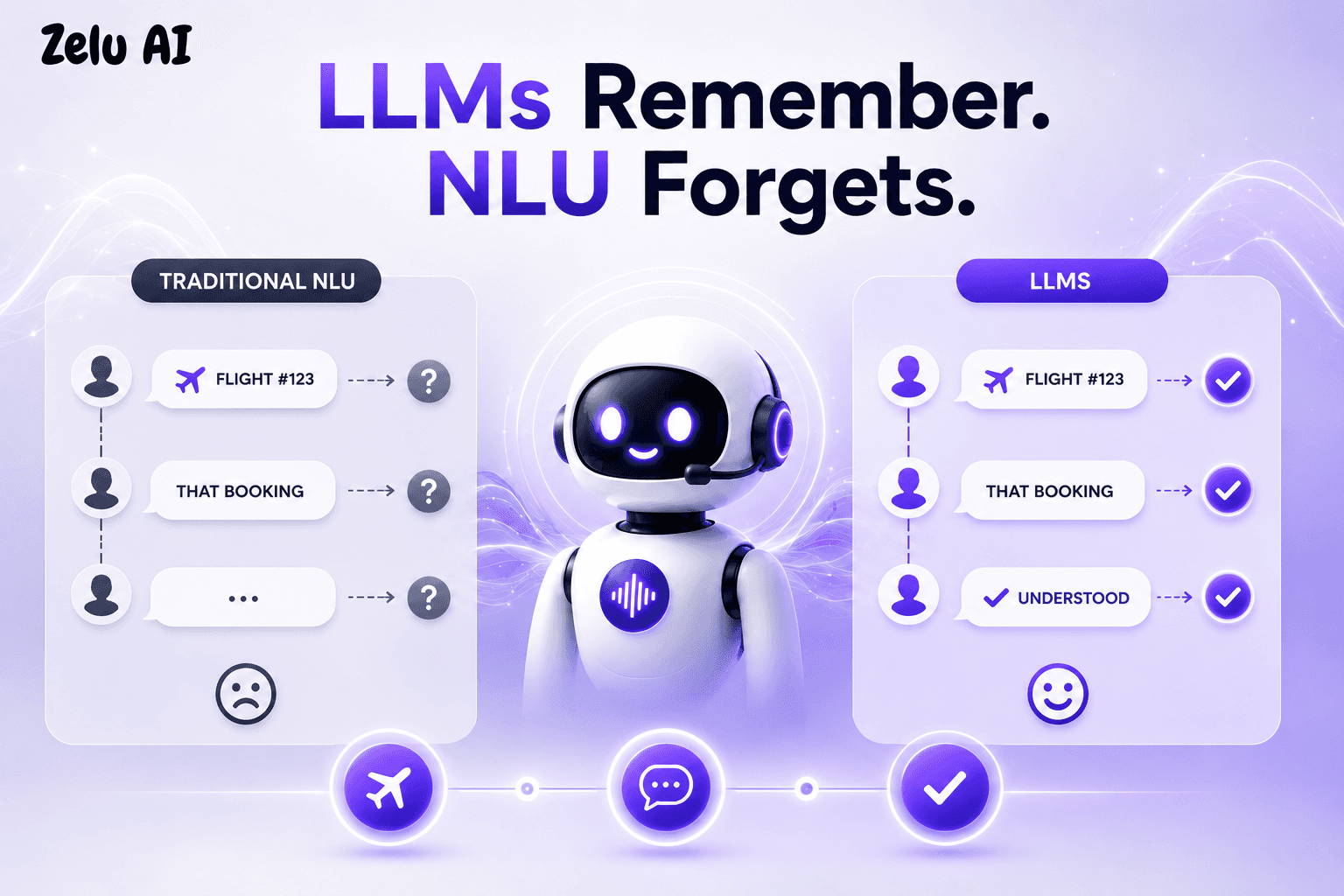
Your customer mentions their flight number in minute one. References "that booking" in minute ten. Traditional NLU asks for clarification.
LLM remembers instantly. Here's why context handling separates intelligent AI from frustratingly forgetful systems.
Understanding how LLMs maintain conversation context better than traditional NLU is crucial for building voice agents and AI systems that actually work. ZeluAI specializes in custom AI agents that leverage this capability to deliver seamless multi-turn conversations. Let's explore what makes the difference.
What Exactly Is Conversation Context?
Context is accumulated information from earlier in a conversation that helps understand new messages. In human conversation, you don't repeat your name constantly because humans maintain context effortlessly.
For AI systems, context maintenance determines whether an interaction feels natural or broken.
Why Context Matters in AI
Users reference previous messages. They ask follow-up questions. They expect systems to remember.
Without context handling, every interaction becomes isolated. Customer mentions a problem. Gets a response. Adds detail. System treats it as completely new. This is digital amnesia—the system asks clarifying questions about information already provided.
Real-World Context Requirements
Multi-turn conversations require continuity. Referential understanding matters: "that issue," pronouns like "it" and "that," contextual references.
Emotional consistency across messages creates trust. Intelligent AI feels like it remembers. Broken AI feels like it's meeting you for the first time every message.
How Do Traditional NLU Systems Approach Context?
NLU's Stateless Architecture
Traditional NLU treats each message as separate, without inherent conversation memory. The architecture is simple: input → categorize intent → extract entities → output.
Conversation memory isn't built in. It's bolted on afterward by applications.
How NLU Handles Context Manually
NLU systems are fundamentally stateless. Each request processes independently from scratch.
Applications must explicitly pass conversation history as arrays of messages. Developers manually code what information to track. An entity gets extracted. A state variable stores it. Every tracked element requires manual coding.
Where NLU Context Breaks Down
This works for predictable, structured conversations. It breaks when conversations go off-script.
Customer says: "Cancel the Thursday meeting but only if I have conflicts." NLU struggles because it requires reasoning about conditions. It needs logic beyond "what is the intent?"
Real-World NLU Failure
Customer in support conversation spans five messages:
Message 1: "I want to book a flight"
Message 3: "Actually, move it to Friday"
NLU doesn't know what "it" refers to. The application must manually track that "it" equals flight. NLU has no automatic referential understanding.
The Cost Problem
As conversations lengthen, NLU context becomes expensive. Including full conversation history in every request costs tokens. Costs money. Increases latency.
Eventually you can't include the full conversation anymore. Information drops off. Context gets lost completely.
What Makes LLMs Better at Understanding Context?
LLMs maintain context through architectural mechanisms that allow them to see the entire conversation simultaneously. Every token has attention to every other token. This is fundamentally different from NLU's stateless approach.
How Attention Maintains Context
LLMs process all prior messages plus the current message together. When processing "move it," the model's attention mechanism looks back to earlier messages.
The model understands what "it" refers to. No external state tracking needed. It's built into the model itself.
The Attention Mechanism Explained
Attention calculates how much focus to pay to each previous token. When processing "move," attention focuses on what needs moving. When processing "it," attention points back to "flight."
The model understands "it" equals the flight to Tokyo and needs date changes. This happens automatically without explicit programming.
In-Context Learning: LLM's Superpower
Show an LLM a format example within conversation, and it follows that format. NLU requires retraining with labeled data. LLM adapts in seconds.
This flexibility matters because conversations are unpredictable. Users ask things training data never covered. LLMs reason through novel requests. NLU escalates them.
Understanding Context Window
Context window is the maximum number of tokens an LLM can see simultaneously. GPT-4 handles 128,000 tokens, roughly 100,000 words. An entire long conversation fits inside one window.
Newer models like Claude hold 200,000 tokens. Google Gemini processes 1 million tokens. This capacity gap widens monthly.
Two Types of LLM Memory
LLMs combine in-weight memory (from training data—general knowledge about the world) with in-context memory (from conversation—specific user preferences and details).
LLMs blend both seamlessly. NLU has no in-weight memory. Must be told everything explicitly.
Where Do NLU and LLM Context Abilities Actually Differ?
NLU requires explicit tracking or clarification. "That issue" means manually knowing what issue was discussed.
LLM looks back through conversation and understands the referent automatically. Real impact: NLU forces users to repeat themselves. LLM feels natural.
Multi-Turn Coherence
NLU treats each turn isolated. Complex multi-step requests break.
Example: "Move my meeting, notify attendees, and update budget." NLU might handle these as separate requests, breaking logical connection. LLM understands it's one coordinated action flowing through the entire model.
Emotional Context Tracking
NLU doesn't track emotional thread. LLM understands frustration patterns.
If a customer asks the same question three times, NLU treats it identically. LLM recognizes the frustration pattern and adjusts response accordingly.
Cost Growth Pattern
NLU keeps costs static once built. Context tracking doesn't change per conversation.
LLM costs increase with conversation length. A 100-message conversation costs 100 times more than a 1-message interaction. This matters at scale.
Context Capacity Limits
NLU realistically tracks 10-20 pieces of information. Anything beyond requires database lookups and extra latency.
LLM holds everything within context window. Hundreds or thousands of information pieces become immediately accessible without separate lookups.
Long Context Accuracy
NLU performance stays stable (doesn't see long context anyway).
LLM performance can degrade with very long contexts. The "lost in the middle" problem occurs, the model misses important information in middle of context window. Solutions are emerging.
When and Why Does Context Matter in Production?
Customer calls, mentions flight number. Two minutes later, customer refers to "my booking." NLU system: "I don't know what booking you mean." Needs clarification.
LLM system understands from context and resolves immediately. Business impact: lower resolution rates, frustrated customers, escalations.
Customer Support Tickets
Ticket chain spans five messages back-and-forth. Final message: "Can you just do what we discussed?"
NLU lacks full conversation context. Must ask for clarification. LLM has entire ticket history. Completes the request directly. Business impact: longer resolution time, poor satisfaction.
Contract and Document Analysis
Long document with cross-references: "as defined in section 3." Question: "Does this comply with section 3?"
NLU has limited context window, must search manually. LLM holds entire document, cross-references automatically. Business impact: faster analysis, fewer errors, lower costs.
Sales Conversation Negotiations
Price negotiation, payment terms, delivery date across multiple messages. NLU might lose track of constraints mentioned earlier. LLM maintains full negotiation context. Business impact: better deal closure, customer trust, fewer misunderstandings.
What Techniques Actually Work for Long Conversations?
Compress older conversation parts into concise summaries. Keep recent messages in full detail.
Retrieval-Augmented Generation (RAG)
Don't include full conversation in context. Instead, retrieve only relevant previous messages.
Convert question to search query. Find matching messages. Include only relevant pieces. Benefit: scalable to extremely long conversations. Trade-off: might miss important context if retrieval fails.
Structured Memory Systems
Extract and store key facts separately. Include only relevant facts when needed.
Example: store ["customer: John," "requested: flight to Tokyo," "preferred: Friday"]. Benefit: compact, queryable, fast. Trade-off: loses conversational nuance.
Hybrid NLU Plus LLM Approach
NLU extracts and tracks structured information to external database. LLM maintains conversational context including tone, history, specific details.
Real implementation: voice agent plus support. NLU extracts customer ID, issue type, resolution status. LLM maintains conversation context. Result: fast extraction plus natural understanding.
Final Thoughts
Understanding context handling changes how you build AI systems. This isn't "LLM is better, NLU is worse", it's understanding fundamentally different approaches.
LLMs excel at automatic referential understanding, multi-turn coherence, conversational tone, and long conversations. NLU still wins at cost, reliability, explainability, and speed.
Hybrid systems combining both strengths are becoming standard. Build intelligent AI by understanding what each approach excels at. Design systems that leverage those strengths.
FAQs
Can we build a custom voice agent that remembers context across multiple customer calls?
Yes. ZeluAI builds custom voice agents using LLM-powered context management with external memory systems that retain context across sessions—contact us for a technical assessment of your specific requirements.
What's the average latency difference between NLU and LLM for real-time voice agents?
NLU processes in 10-50ms, LLM in 300-2000ms depending on complexity—for voice agents requiring <500ms latency, hybrid approaches routing simple queries to NLU work best.
Can NLU systems be upgraded to handle context like LLMs without replacing them?
Partially, adding external memory layers helps, but you can't replicate LLM's automatic attention-based context flow; hybrid systems (NLU + LLM) provide the best balance of reliability and capability.
How do retrieval-augmented generation systems perform compared to raw context inclusion for very long conversations?
RAG systems reduce token costs by 60-80% and maintain higher accuracy on long contexts (20+ hours of conversation) compared to raw context inclusion, making them ideal for persistent AI agents.