رؤى
/
16 فبراير 2025
AI Lead Generation for Small Business: How It Actually Works
AI Lead Generation for Small Business
/
مؤلف

غرايسيا بيركين
A prospect visits a small business's website three times in a week, opens every email in a follow-up sequence, and never gets a call. Somewhere in that pattern was a buyer ready to talk, and nobody noticed in time to reach them, because nobody was watching for the pattern in the first place.
At ZeluAI, this is the exact gap AI lead generation is built to close. It's often described as "marketing on autopilot," but the more useful way to understand it is as a system that notices patterns a busy small business owner simply doesn't have time to track.
What Is AI Lead Generation for Small Business?
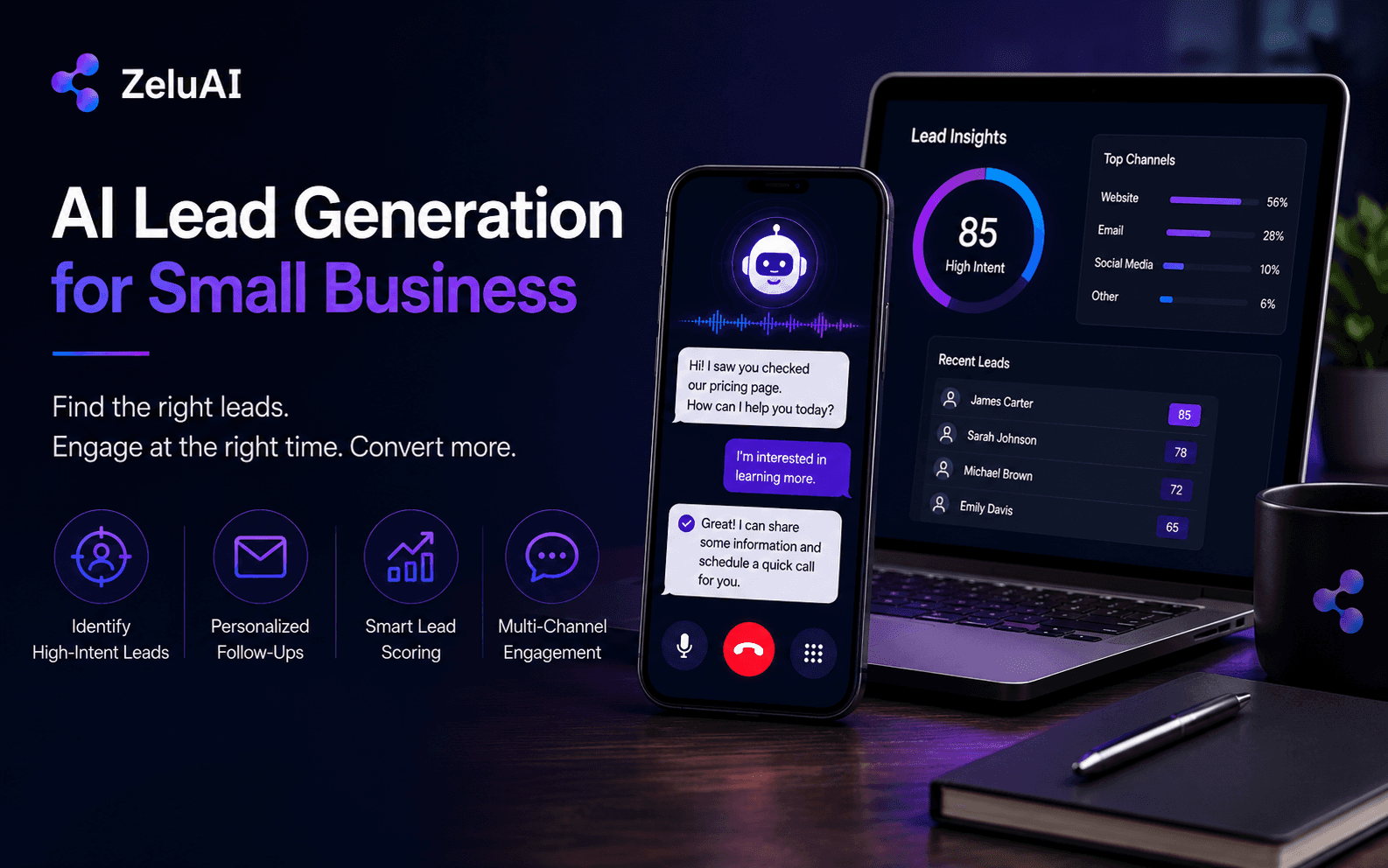
AI lead generation uses machine learning and natural language processing to identify, qualify, and follow up with potential customers, learning from outcomes rather than following a single fixed script. It watches for signals, repeated site visits, email engagement, the kind of question someone asks, and uses those signals to decide who's worth prioritizing right now.
The goal isn't replacing a small business's sales process. It's making sure the version of that process already happening in someone's head, "this person seems interested," actually gets acted on consistently, instead of depending on whoever happens to notice first.
How Is This Different From Regular Marketing Automation?
Marketing automation runs on fixed rules: if someone opens an email, send the next one in the sequence. It executes the same steps regardless of context. AI lead generation goes further by analyzing outcomes and adjusting its own behavior, prioritizing a lead differently based on what's actually happened so far, not just which step of a sequence they're on.
This is the same distinction we cover in more depth in our piece on rule-based automation vs agentic AI, where predictable, rule-following systems and adaptive, learning-based systems solve genuinely different problems, even though both get called "automation."
How Does AI Actually Find and Qualify Leads?
Underneath the surface, the system tracks behavioral signals: how often someone visits a website, which pages they spend time on, whether they've opened or replied to previous messages, and how their activity compares to people who've bought before.
These signals get combined into a sense of how ready someone actually is, rather than treating every inbound inquiry identically.
How Does Lead Scoring Actually Work?
Lead scoring assigns a value to specific actions, opening an email might add a small amount, visiting a page about a specific service might add more, replying to a message adds significantly more, and totals these up to flag which leads deserve immediate attention versus which ones are still just browsing.
The scoring model improves over time by learning which combinations of signals actually preceded a real conversion in the past.
How Does Follow-Up Automation Actually Work?
Once a lead is identified, follow-up automation handles the outreach itself, drafting a message, choosing when to send it, and adjusting the next step based on whether the person opened it, replied, or went quiet. This removes the dependency on a busy owner remembering to follow up at exactly the right moment.
What Makes a Follow-Up Feel Personal Rather Than Automated?
The difference comes down to specificity. A message referencing the actual page someone visited or the specific question they asked reads as attentive. A generic template sent to everyone reads as exactly what it is, regardless of how quickly it went out.
Where Does This Deliver the Fastest Results for a Small Business?
The fastest win almost always comes from fixing response speed before adding more traffic. A missed call, an unanswered web form, or a slow reply to a chat inquiry loses a prospect just as fast as never reaching them at all.
Improving how quickly and consistently existing inquiries get a response tends to matter more, early on, than driving additional visitors to a website that isn't converting the ones it already gets.
What Can't AI Lead Generation Fix?
This is worth being direct about. If a business's positioning is unclear, if the offer doesn't actually solve a problem people recognize, or if follow-up has always been inconsistent, AI doesn't fix any of that.
It just does those same things faster and at greater volume, which tends to expose the underlying problem rather than solve it, often more quickly and more visibly than before.
If the profile of who counts as a good customer is wrong, the system will find more of the wrong people efficiently. The technology handles discovery, scoring, and drafting well.
It doesn't replace judgment about who's actually worth pursuing or whether the offer being pitched is genuinely compelling to the people receiving it.
How Does It Connect to the Tools a Business Already Uses?
For this to actually save time rather than create a second system to manage, it needs to sync with the CRM or contact list a business already relies on, so a scored lead and its full history show up in one place, not scattered across separate tools.
The same principle applies to how we think about voice-based lead capture, covered in our piece on what an AI receptionist actually handles, where the real value sits in the connection to existing systems, not the conversation or outreach in isolation.
How Should a Small Business Get Started?
The strongest starting point is usually a single bottleneck, slow response to inbound inquiries, inconsistent follow-up, or leads that fall through the cracks after the first message, rather than trying to automate the entire sales process at once. Fixing one clear gap first tends to produce results a business can actually see before expanding further.
At ZeluAI, we build AI agents designed around exactly this kind of pattern recognition and follow-up problem, connecting lead identification directly to the systems a business already uses. You can see the fuller range of what these systems are built to do on our services page.
Final Thoughts
AI lead generation isn't magic that manufactures interest out of nothing. It's a way of noticing the interest that's already there, a repeat visitor, an opened email, an unanswered question, and making sure it gets followed up on consistently instead of depending on luck or timing.
Businesses that start by fixing their weakest link, usually response speed or follow-up consistency, tend to see the clearest results before adding more complexity. Understanding what this technology can and can't fix is a better starting point than any tool comparison.
Frequently Asked Questions
Does AI lead generation work for local service businesses, or only B2B and SaaS?
It works for both, though the signals that matter differ, local businesses often benefit most from faster response to calls and inquiries, while B2B businesses benefit more from behavioral scoring across a longer sales cycle.
Can a small business use this without a dedicated marketing person?
Yes, most systems are designed to run with minimal day-to-day management once the initial setup and messaging are in place.
Does AI lead generation replace paid advertising, or work alongside it?
It works alongside it, since better follow-up on existing inquiries doesn't reduce the value of also attracting new ones through advertising.
How quickly can a small business expect to see qualified leads after setup?
Most businesses see clearer lead prioritization within the first few weeks, though the scoring model tends to improve further as it learns from more outcomes over time.
Can AI lead generation work across multiple channels at once?
Yes, well-built systems can track and respond across email, website activity, and social inquiries simultaneously rather than treating each channel separately.